



Why solids removal comes first
Solids break down in the water. The longer they stay, the more they turn into fine particles and ammonia, and the more oxygen they use. In a DTU comparison, systems with drum filters had over 60% less particles, particulate BOD and particulate COD than systems without (DTU). Every stage after the filter, from the biofilter to the UV, works better when solids leave early. See aquaculture filtration for how the stages fit together.
The five options at a glance
| Unit | How it works | What it removes | Typical use |
|---|---|---|---|
| Drum filter | Rotating screen, backwashed by spray nozzles | Particles above the screen size, often 40–100 μm | Main solids removal on commercial RAS |
| Disc filter | Screen panels on rotating discs | Similar to a drum, sometimes finer | Large flows where floor space is tight |
| Bead filter | Floating plastic beads trap solids, cleaned by agitation | Fine particles; also some biofiltration | Small systems, hatcheries, ornamental ponds |
| Settler | Slows water so heavy particles sink | Heavy, fast-settling solids | Ahead of a drum where solids load is high |
| Protein skimmer | Fine bubbles lift particles and organics into foam | Very fine particles and dissolved organics | Marine, shrimp and dense freshwater systems |
Drum filters
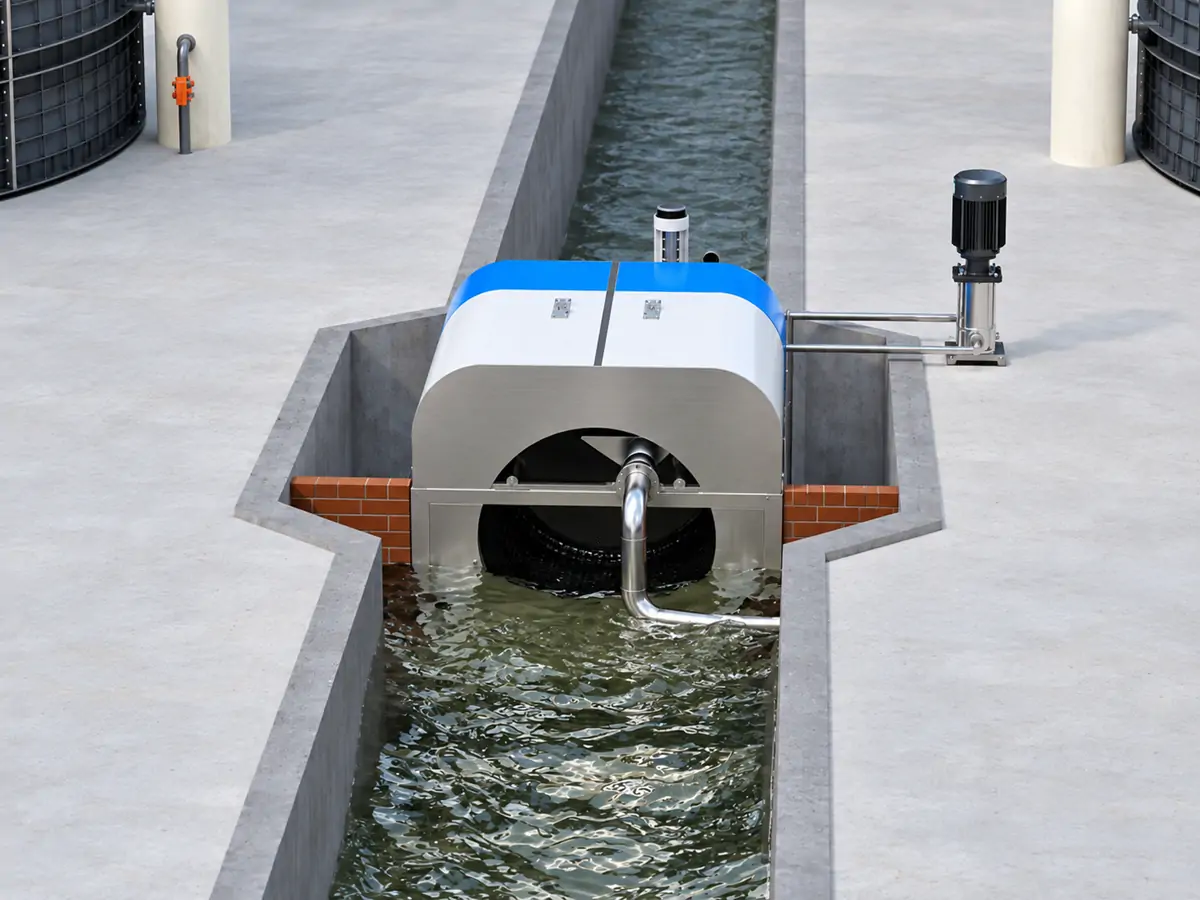
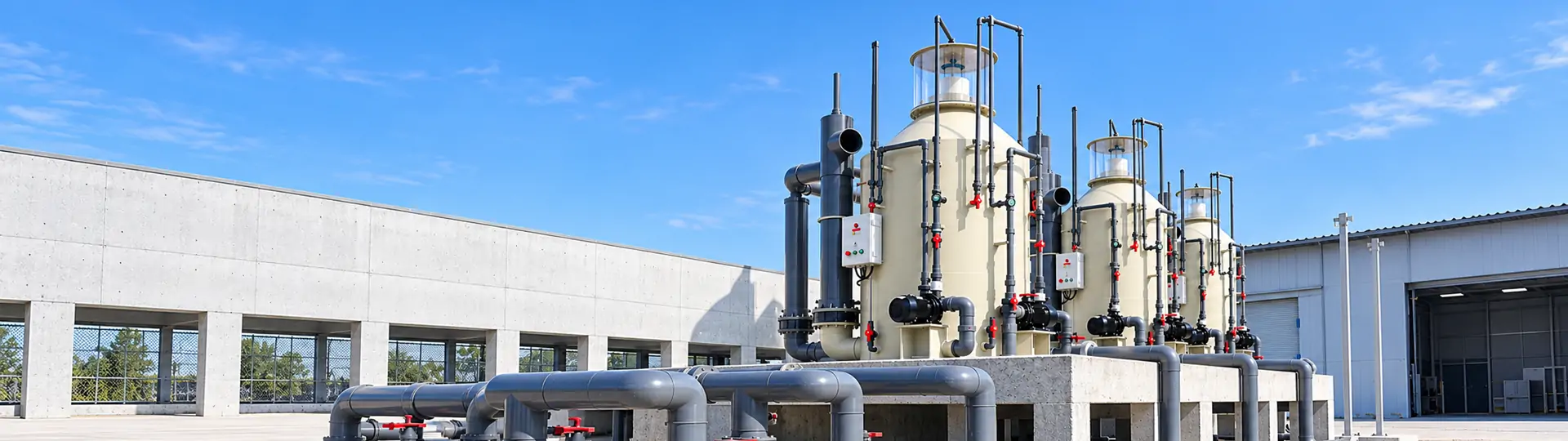
A drum filter passes water through a rotating screen. Solids caught on the screen are washed off into a waste channel when the water level rises or on a timer. It runs continuously, removes solids within minutes of leaving the tank, and handles flows from a few cubic metres to several hundred cubic metres per hour per unit.
Screen size is a trade-off. A 2025 trout trial found 45 μm gave better water quality than 70 μm, and 30 μm gave no further gain (DTU 2025). Finer screens catch more but pass less water per drum and backwash more often.
Watch for: backwash water use, spray nozzle blockage, and the rated flow being stated for clean water only. Ask the supplier for flow at your solids load.
Disc filters
A disc filter does the same job as a drum, with the screen mounted on a row of discs instead of one cylinder. This gives more screen area in a smaller footprint, which suits very large flows. Disc filters are more common in large salmon farms and wastewater plants than in small and mid-size RAS. The choice between drum and disc is mostly about flow, floor space and service access.
Bead filters
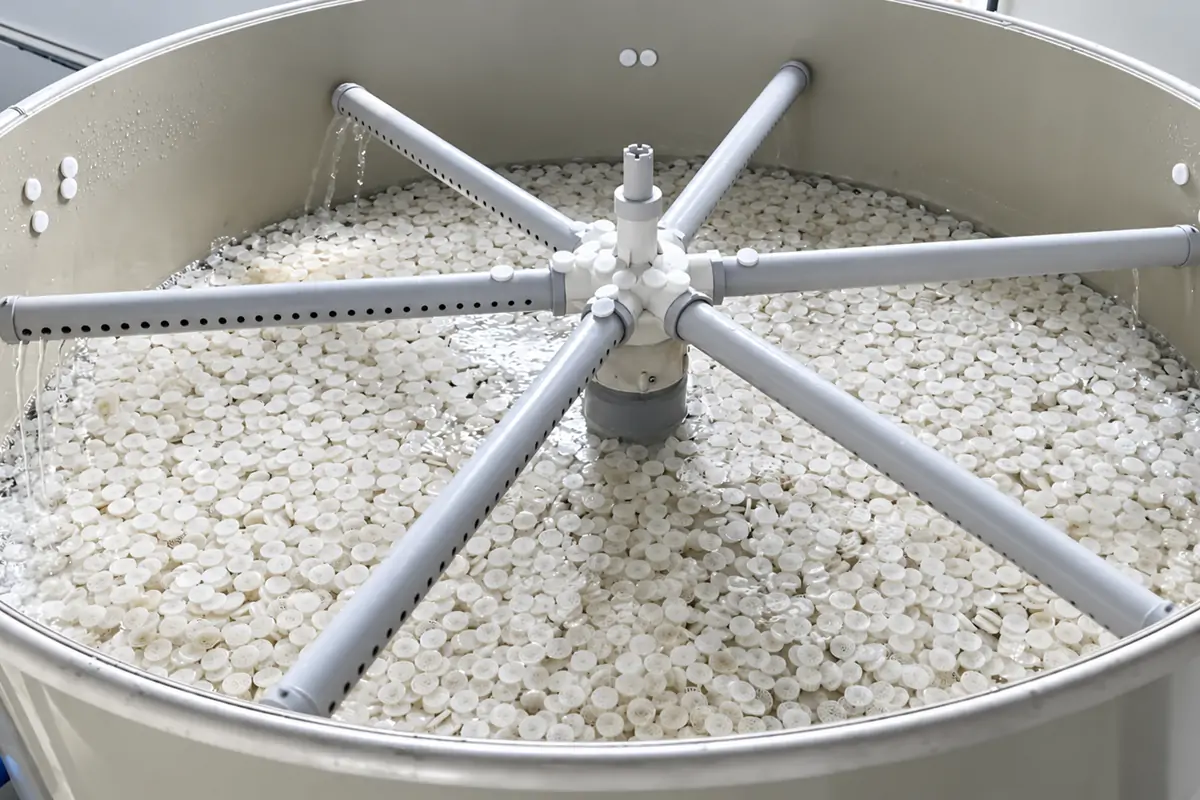
A bead filter is a pressure vessel filled with small floating plastic beads. Water passes up or down through the bead bed, which traps fine solids. The beads are cleaned by agitating them and draining the waste. Because bacteria also grow on the beads, a bead filter does some biofiltration as well.
Bead filters work well in small systems, quarantine units and hatcheries. In large commercial grow-out they become hard to manage: solids stay in the bed between cleanings, where they break down, and the pressure vessels add pump energy. Most commercial farms use drum filters for the main flow and keep bead filters, if at all, for small side systems.
Settlers
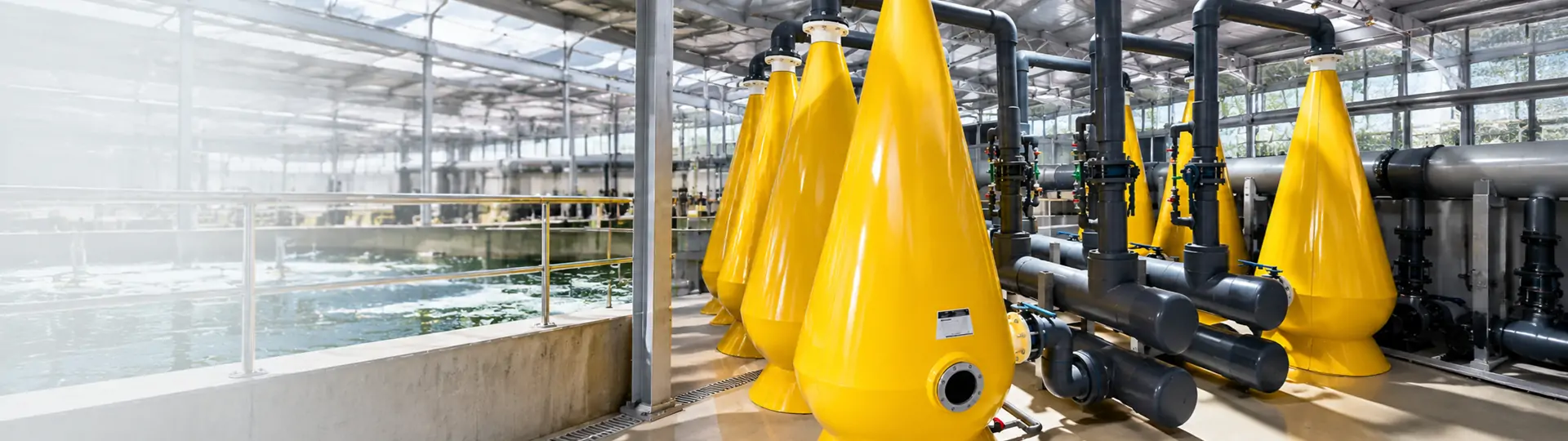
A settler, sometimes called a swirl separator or radial flow settler, slows the water so heavy particles sink to a cone at the bottom. It has no screen and few moving parts. It does not catch fine particles, so it is used ahead of a drum filter, not instead of one. Where feed rates are high, a settler takes the heaviest fraction and reduces drum backwash. Some farms also use a settler on the tank’s bottom drain, where most of the heavy solids leave.
Protein skimmers
A protein skimmer, or foam fractionator, injects fine air bubbles into a column of water. Very fine particles and dissolved organics stick to the bubbles and leave as foam. This is the only unit in this list that removes dissolved organics. Foam forms more easily in seawater, so skimmers are standard in marine and shrimp systems. In freshwater they are used in dense systems, often with ozone.
Side by side
| Drum | Disc | Bead | Settler | Skimmer | |
|---|---|---|---|---|---|
| Fine particles | Good | Good | Good | Poor | Very good |
| Dissolved organics | No | No | No | No | Yes |
| Large flows | Yes | Yes | Limited | Yes | Side stream |
| Solids leave the loop | Within minutes | Within minutes | At each cleaning | At each sludge draw | Continuously |
| Power use | Low | Low | Higher, pressure pump | None | Pump or air |
| Main maintenance | Nozzles, screen | Screen panels | Bead cleaning cycles | Sludge removal | Foam cup, air inlet |
Which do you need?
- Commercial freshwater grow-out: drum filter on the main flow. Add a settler if the feed rate is high.
- Marine or shrimp: drum filter plus protein skimmer, often with ozone.
- Dense freshwater with water quality problems: drum filter plus a skimmer on a side stream.
- Very large flows with little floor space: consider disc filters.
- Small hatchery or quarantine system: a bead filter or a small drum can both work.
The trial evidence supports combinations. In a 2025 freshwater trout trial, a swirl separator combined with a foam fractionator cut total BOD by 40%, total COD by 27% and microbial activity by over 55% compared with a drum filter alone (DTU 2025).
Size on peak flow and peak solids
Whichever units you choose, size them on the peak flow and the solids produced on the peak feed day, not on averages. A drum filter that is right for the average day overflows its bypass after the largest feed. Send your design flow, peak daily feed and water type, and we size the full solids line with the rest of the loop. See the filtration overview for our range.