




Eel nursery and grow-out, indoors.
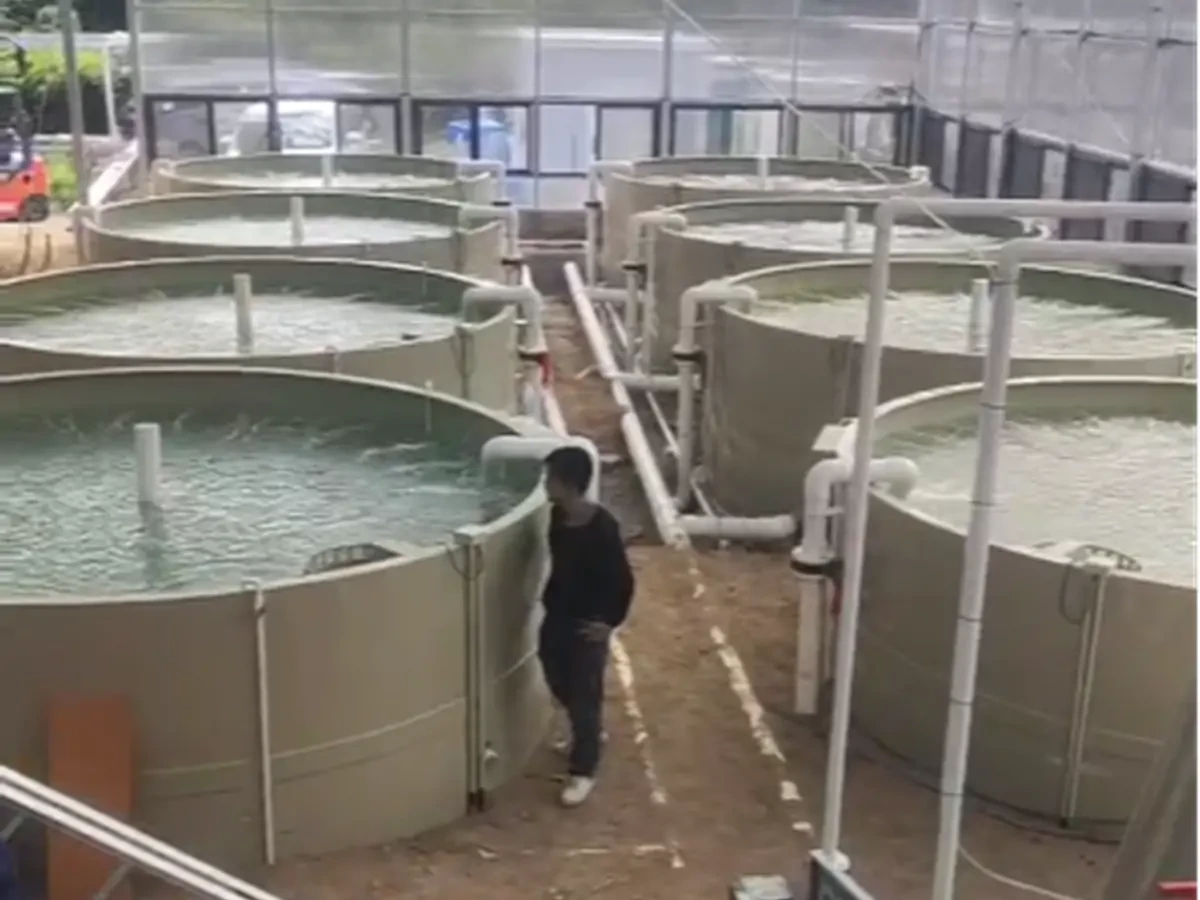
Eels need warm, steady water, shallow tanks and frequent grading. Two eel projects delivered: an 11-tank nursery in Japan inside a building that could not be dug, and a 720 m³ upgrade in Shaxian, China.
delivered eel projects
nursery, Japan
upgrade, Shaxian
published optimum
Each stage needs a different tank.
European eel farming today is mainly done in recirculation systems, with water held steady around 24 °C (). Eels are stocked by tank floor area, not volume, because they live on the bottom. These are the published stage figures.FAO, European eel culture
Glass eel, quarantine
About 0.33 g
Small tanks, 3–4 m²
10–15 kg/m²
Juvenile
From about 5 g
6–8 m²
50–75 kg/m²
Grow-out
Stocked at about 50 g
Square or round, 25–100 m²
Up to 100–150 kg/m²
Market
120–180 g or 300–600 g for smoking; about 150–200 g for kabayaki
—
—
Density per m² of floor. We design eel tanks shallow and wide, so the floor area does the work.
Warm and steady, all year.
The published optimum for heated eel farming is 24–26 °C (). In a closed loop that means the building and heating are part of the design: an insulated hall, limited make-up water, and heat recovered where it can be.FAO, European eel culture
- so heat stays inInsulated building,
- so you heat less new waterLimited make-up water,
- because small nursery volumes change temperature fastStable control,
- for the coldest weekStandby heat
Eels grow unevenly, so you sort them often.
Individual eels grow at very different rates. Published practice is to grade about every 6 weeks, and to stop feeding at least 1–2 days before grading or harvest (). The layout has to make that easy.FAO, European eel culture
More, smaller tanks
Room to split each grade
Easy access to every tank
Grading every 6 weeks is a lot of handling
Separate nursery loop
Glass eels quarantined from grow-out stock
Drains and screens sized for eels
Eels escape through gaps other fish cannot
11 tanks in a building that could not be dug.
The Japan eel nursery sits inside a building where excavation was not possible. We fitted 11 tanks and the treatment loop into it without digging.
- nursery240 m³
- indoors11 tanks
- in the buildingNo excavation
When an eel system goes wrong.
Wide size spread
Grading too infrequent
Grading every 6 weeks
Poor feeding in the nursery
Temperature unstable, or weaning too fast
Temperature log; weaning plan
Eels found outside tanks
Gaps at drains, screens or lids
Screens and covers
Losses after a new batch
Disease brought in with glass eels
Quarantine; UV on the nursery loop
Heating bill high
Too much make-up water
Water exchange; insulation
Eel projects in two countries.
Nursery and upgrade
A nursery in Japan, an upgrade in Shaxian.
Fits your building
Japan: no digging, 11 tanks fitted in.
Made in our factory
Tanks, drum filters, MBBR and UV.
On site to start-up
Engineers stay until the biofilter is running.
Eel projects we delivered.
11 tanks inside a building that could not be dug
Yes. Our Japan project is an eel nursery. Glass eels start in small quarantine tanks; published practice is 3–4 m² tanks at 10–15 kg/m².
The published optimum for heated eel farming is 24–26 °C, held steady.
Eels live on the tank floor. Published grow-out densities are given per m² of floor, up to 100–150 kg/m².
About every 6 weeks, because individual growth varies widely.
Yes. Our Shaxian project is a 720 m³ eel upgrade.
Yes. In Japan we fitted the farm into a building that could not be dug.
A first layout comes back in 3 days, free.
Send your building and output. Get an eel layout.
Stage, target output and the building. A first layout comes back in 3 days, free.
- Layout, equipment list and flow balance
- Sized on your species and feed
- Made in our 12,000 m² factory
- No obligation to order