



Start with one train. Add the next when you are ready.
A modular RAS splits the farm into parallel treatment trains. Each serves its own group of tanks, so you can grow in steps and one fault never stops the whole farm. Below: when it is worth it, and when one loop is the better choice.
parallel trains, Kazakhstan
tanks on those trains
tilapia, Kazakhstan
can stock while the next is built
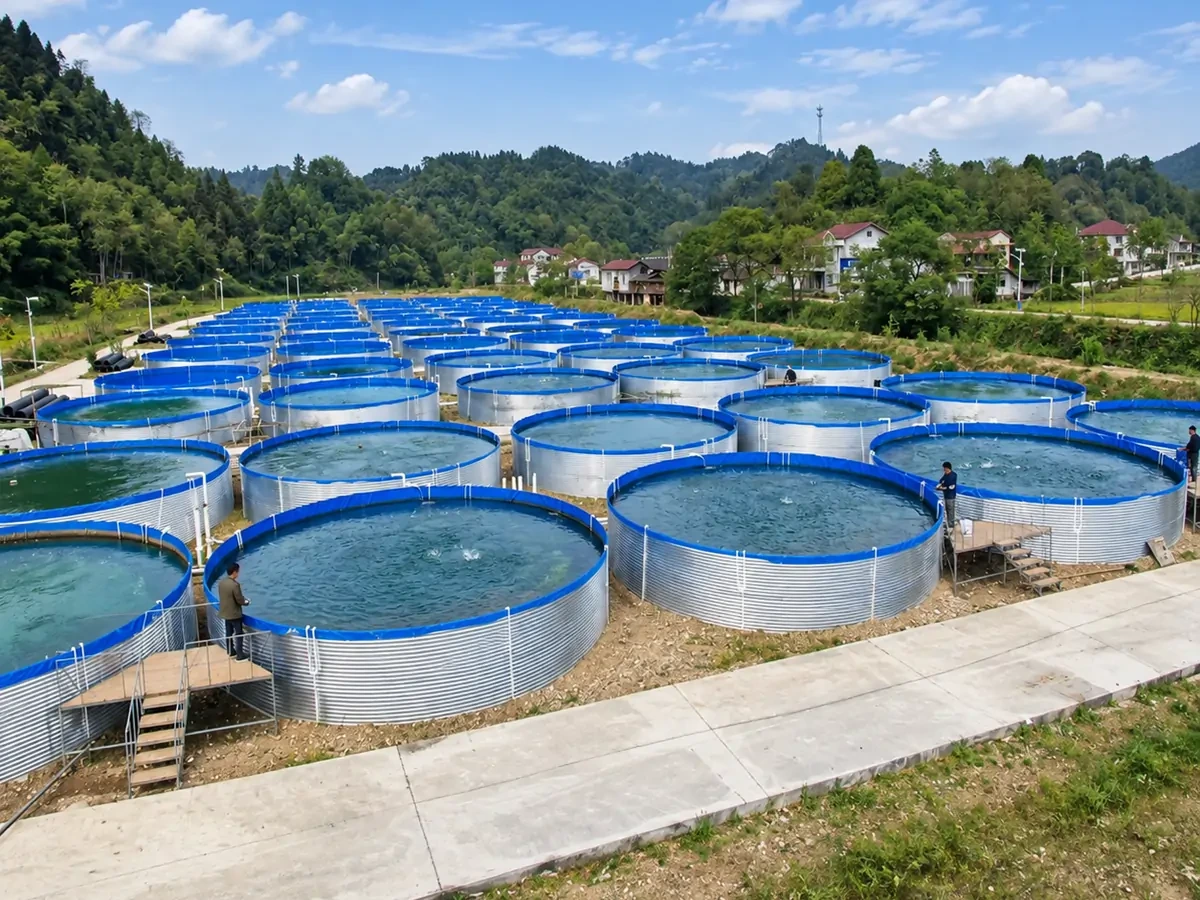
52 tanks on six parallel trains.
The Kazakhstan farm runs 52 tanks on six parallel treatment trains, designed for a cold winter. Splitting the farm into six trains means no single loop carries the whole farm. A fault in one train does not stop the others.
- tilapia2,160 m³
- six trains52 tanks
- designed for the climateCold winter
The trade-off, side by side.
Equipment count
Fewer, larger units
More, smaller units
Investment
All at once
In steps, one train at a time
A pump or biofilter problem
Can affect every tank
Stays in one train
Disease
Shared water reaches every tank
Contained to one train
Cleaning and repair
The whole farm is affected
One train at a time while the others run
Spares
Fewer, larger parts
Same parts in every train; fewer types to stock
Start-up
The whole biofilter must mature before full stocking
The first train can stock while the next is built
More units usually means a higher equipment count than one large loop. In return you get staged investment and lower risk. When it helps, the first layout shows both options.
Each train is a complete, small RAS.
A train has its own drum filter, biofilter, degassing, oxygen and UV, sized on the tanks it serves.
Farm output
Target tonnes a year for the whole farm.
Number of trains
Set by how you want to invest, the building layout and the risk you accept.
Tanks per train
A group of tanks with one stocking plan, so feed per train is steady.
Equipment per train
Every stage sized on that train’s peak feed; identical across trains.
Modular fits some farms better than others.
Funding or sales will grow over several years
Yes: add trains as they grow
High-value stock or high disease risk
Yes: problems stay in one train
Several species or stages on one site
Yes: one train per species or stage
Small farm, one species, one stocking plan
Often not: one loop is simpler
Very tight budget and no plans to expand
Often not: fewer units cost less
Drawings in 3 days. A packed system in 35.
3days
First layout
Tank layout, equipment list and flow balance, free.
7days
Samples
Sample units for OEM and distributor orders.
15days
Standard units
Standard equipment built and packed.
35days
Custom system
Built, tested and packed. Install and start-up follow on site.
Repeatable trains from one factory.
Six trains delivered
Kazakhstan, 52 tanks.
Same units every time
Tanks, drum filters, MBBR and UV from our factory.
Both options shown
One loop or trains, in the first layout when it helps.
15-day standard units
Fast to repeat a train.
Farms we delivered.
52 tanks, six parallel trains, one cold winter
Keep the tanks. Change the water.
It depends on species, output and building. We size trains in the first layout.
Parallel trains use more units than one large loop. In return you get staged investment and lower risk. The first layout shows both options when it helps.
Yes. Send the current layout and the equipment you run.
Oxygen supply and power are often shared, with standby. Water treatment stays separate, or the trains lose their risk benefit.
Enough that losing one does not stop the business, and few enough to manage. Kazakhstan uses six for 52 tanks.
Yes. A finished train can start its biofilter and stock while the next is built.
Send your target output. We split it into trains.
Send species, target output and site size. A first layout comes back in 3 days, free.
- One loop or trains, compared
- Identical equipment per train
- Staged investment plan
- No obligation to order