




Remove what the drum filter cannot catch.
Fine particles and dissolved organics pass through any screen. A protein skimmer lifts them out as foam. Below: what it removes, how it is run, and what to check when the foam stops.
and dissolved organics
water
for higher removal
standard units ship
Takes out the fine fraction the screen lets through.
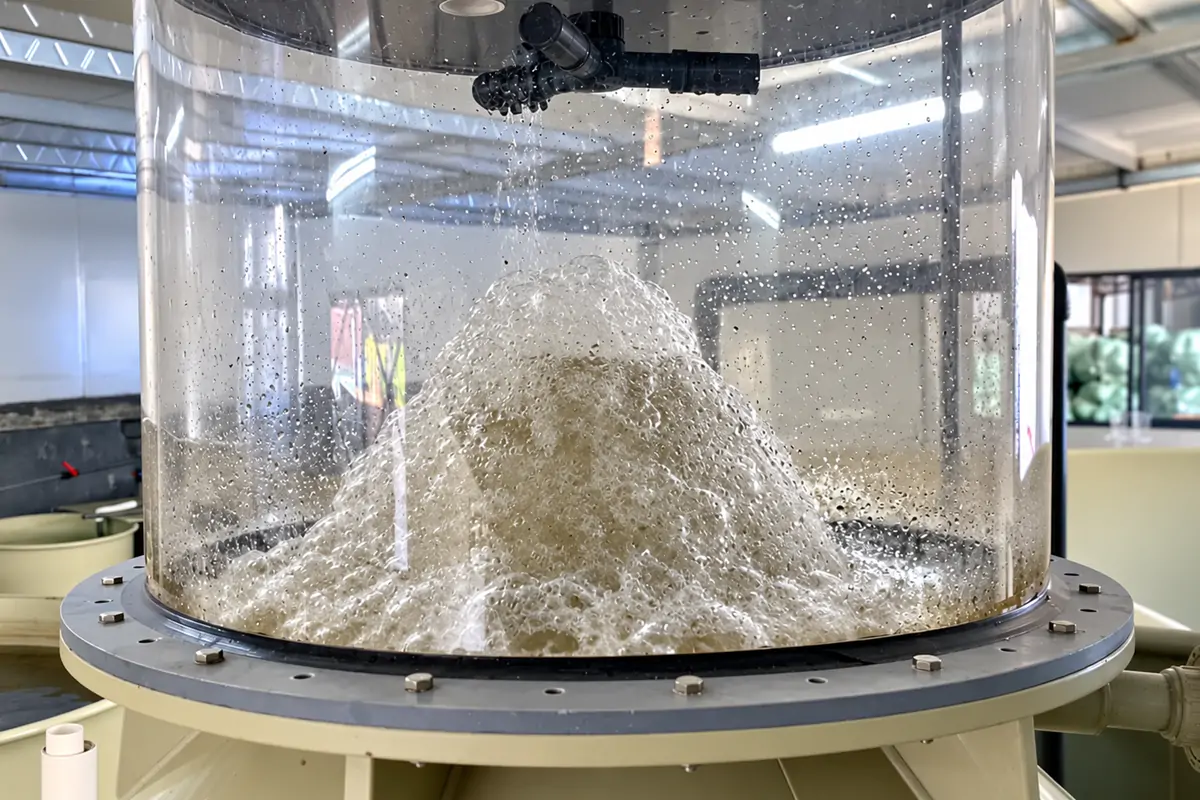
Organic molecules and fine particles stick to the surface of air bubbles and rise as foam. A drum filter cannot catch particles smaller than its mesh, and no screen catches dissolved organics. In a freshwater trout RAS trial, adding foam fractionation gave the clearest water: a swirl separator with a foam fractionator cut total BOD by 40%, total COD by 27% and microbial activity by over 55% against a drum filter alone ().Aquacultural Engineering, 2025
- fine particles, dissolved organics, some bacteriaRemoves:
- turbidity, UV transmittance and oxygen demandImproves:
- ammonia, or the coarse solids a drum filter takes. It works after the drum, not instead of it.Does not remove:
Drum alone, or drum plus foam.
Averages from the last three weeks of the same 2025 trial (). Freshwater, rainbow trout, 12 pilot RAS.Aquacultural Engineering, 2025
Total COD, mg/L
35.7
30.6
26.1
Turbidity, FNU
3.41
3.06
2.04
UV transmission, %
50.4
53.9
58.2
Particles, million per ml
3.21
1.56
1.24
Clearer water with higher UV transmission also makes UV disinfection more effective.
Foam forms more easily in seawater.
Salt helps bubbles stay small and foam stay stable, so skimmers remove more in seawater. In freshwater, foam forms less readily, yet the trial above shows clear gains in dense freshwater systems too.
Marine RAS
Standard. Usually with ozone
Shrimp, brackish
Recommended. High organic loads
Dense freshwater
Optional. Helps where colour and fine solids build up
Low-density freshwater
Usually not needed
Retention time, air, ozone.
Three settings decide what a skimmer removes. A study of two full-scale skimmers in a commercial seawater RAS tested them side by side.
Retention time
How long water stays in the column. Moving from 1.8 to 2.2 minutes had a moderate effect on microparticles; the shorter time treats more water per day.
Air and bubble size
Fine bubbles give more surface for organics to stick to. Air flow sets how much foam forms.
Ozone dose
The strongest factor. Ozone at 7 g per kg feed improved water quality; 14 g raised residual oxidant.
Share of flow
Skimmers usually treat a side stream. The share of the loop treated each hour sets how fast fines are removed.
Retention time and ozone findings: , commercial seawater RAS. The skimmer design itself made little difference to water quality in that study.Aquacultural Engineering, 2023
When the foam goes wrong.
Little or no foam
Low organic load, low air flow, or a recent change in water chemistry
Air flow; water level in the column; ozone dose
Wet foam overflowing
Water level too high, or too much air
Level setting; air flow
Foam collapses before the cup
Bubbles too large, or oil or chemicals in the water
Air injector; recent treatments
Water quality not improving
Too small a share of flow treated
Side-stream flow against the design
Residual oxidant after ozone
Ozone dose too high for the demand
Reduce dose; check ORP and residual oxidant
Skimmer, ozone and drum sized together.
A skimmer sized on its own can treat too little flow to matter. We size it against your feed, the drum ahead of it and the ozone dose.
Made in our factory
Protein skimmers are made in our 12,000 m² factory in Boluo, Huizhou.
Fresh and seawater
Material confirmed against your water type.
Sized on the loop
Side-stream flow and retention time from your feed and system volume.
15 days
Standard units ship in 15 days.
Standard specification.
Function
Removes fine particles and dissolved organics as foam
Material
Confirmed against water type
Water
Seawater, brackish, freshwater
Ozone
Can be paired with an ozone generator
Flow, retention time, air
Confirmed per model
Lead time
Standard units 15 days
Model flow, dimensions, air supply and connections are listed in the datasheet. We confirm the model against your system before quoting.
Shrimp systems we delivered.
1,200 m³ shrimp and bass RAS, Fangcaohu
Foam forms less readily in freshwater, so removal per pass is lower. In a 2025 freshwater trout trial, adding foam fractionation still gave the clearest water, so it helps in dense freshwater systems, especially with ozone.
Ozone breaks down organics and improves foam formation, so the skimmer removes more. In a commercial seawater study, ozone dose was the factor that mattered most.
In the seawater study, 7 g of ozone per kg of feed improved water quality, while 14 g raised residual oxidant. Your dose is set by measurement at start-up.
After the drum filter, usually on a side stream.
No. The drum filter takes the coarse solids. The skimmer takes the fine fraction left over.
No. Ammonia is dissolved and needs the biofilter.
Keep the air injector and foam cup clean, and check the water level setting. Foam cup drains need to stay clear.
Send your system. We size the skimmer and the loop.
Species, salinity, peak daily feed and system volume.
- Side-stream flow sized on feed
- Ozone dose planned
- Made in our factory
- Standard units ship in 15 days