



Dissolve oxygen, don’t bubble it away.
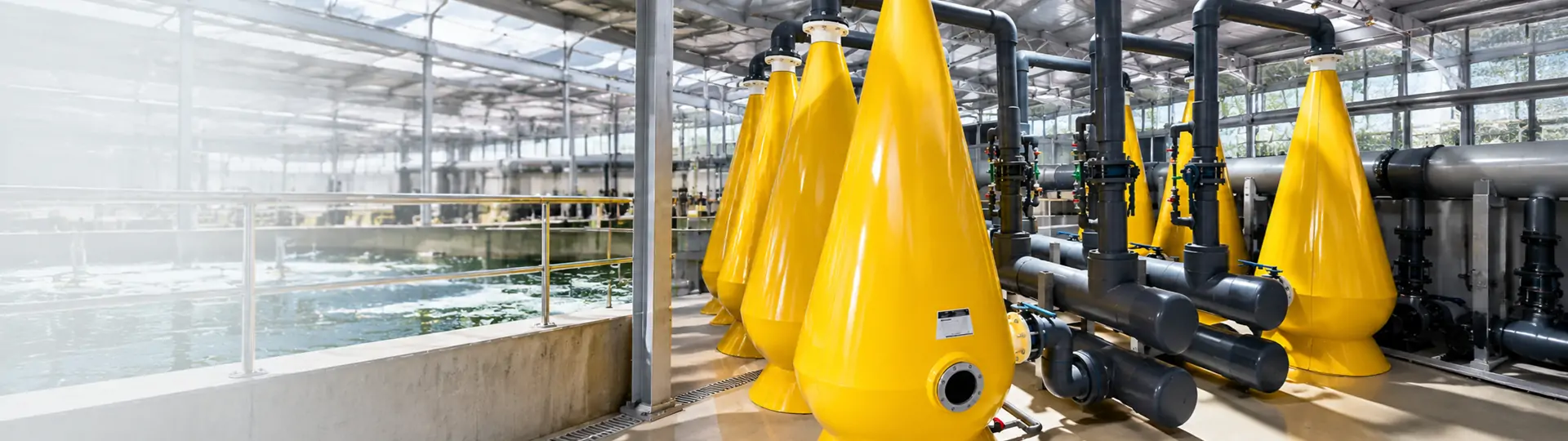
Pure oxygen costs money to make or buy. An oxygen cone holds water and gas together under pressure until the oxygen dissolves. Below: how it works, how it is sized, and the gas problems to avoid.
gas and water held together
or full flow
inside the cone
standard units ship
Pressure and contact time.
Water and oxygen enter at the narrow top. The cone widens downward, so the water slows until it moves down no faster than the bubbles rise. The bubbles hang in the cone and dissolve. Pressure from the pump lets the water hold far more oxygen than it could at the surface. Oxygen-rich water leaves at the bottom and mixes into the return flow.
Where a cone fits.
مخروط الأكسجين
Highest; close to full transfer when sized right
Little oxygen lost; compact
Needs a pump and its energy
Injector / venturi
About 70–80% (Novair)
Simple, cheap
More oxygen lost to air
Diffusers in the tank
Lower; bubbles escape at the surface
Simple, also useful as backup
Wastes the most oxygen
Low-head oxygenator
Good at low pressure
Low pumping energy
Larger; needs head in the layout
Many farms keep diffusers in the tanks as emergency backup even when cones supply the daily oxygen.
Oxygen needed, flow through the cone, pressure.
A cone does not make oxygen. It sets how much of it reaches the fish. These are the numbers we balance.
Oxygen to deliver
From peak oxygen demand, which comes from peak feed. This is the same number that sizes the oxygen supply.
Side-stream flow
Usually part of the return flow goes through the cone. The more oxygen each m³ carries, the smaller that flow can be.
Operating pressure
Higher pressure dissolves more oxygen per m³ but costs pump energy. The pump and cone are chosen together.
Where it mixes
Super-oxygenated water must mix with the main flow before the fish, so no tank gets water far above the target.
A worked example
If 50 m³/h passes through a cone and leaves carrying 20 mg/L more oxygen than it came in with, the cone delivers 50 × 20 = 1,000 g, or 1 kg of oxygen an hour. Double the oxygen demand and you need double the flow, or more pressure. Illustrative figures, not a quote.
Too much gas is also a problem.
Water can carry more gas than it should. When total gas pressure is too high, bubbles form in the fish: gas bubble disease. A widely used US EPA guideline sets total gas pressure at no more than 110% of local air pressure, and a review notes that 103% can harm some species and young fish ().International Journal of Recirculating Aquaculture, 2005
Air drawn into a pump
The same review notes it can push gas saturation to about 110% in under 5 minutes
Air leaks on the suction side; a vortex in the sump when the level is low
Water heated quickly
Warm water holds less gas, so dissolved gas comes out of solution
Degas heated water before it reaches the fish
Cone water not mixed
Fish in the path of super-oxygenated water
Where the cone outlet joins the main flow
Oxygen set too high
High oxygen in the tank, with no benefit to growth
Oxygen probe and set point
Pure oxygen from a cone can lower nitrogen in the water, which helps. Air leaks and heating are the usual causes of trouble. A total gas pressure meter tells you which one it is.
When oxygen does not reach the fish.
Tank oxygen low, oxygen flowing
Cone flow or pressure too low
Pump; valve settings; pressure gauge on the cone
Gas building up at the top of the cone
More gas than the cone can dissolve, or low-purity oxygen
Oxygen flow against cone rating; oxygen purity; vent
Oxygen use higher than expected
Gas escaping through the vent or a leak
Vent setting; joints on the oxygen line
Bubbles in the tank at the outlet
Undissolved gas carried out
Cone flow and gas flow; mixing point
Cone, pump and oxygen sized as one.
A cone sized without the pump and the oxygen supply wastes one of them. We size all three from your feed plan.
Sized on peak demand
Oxygen to deliver, cone flow and pressure, with the numbers sent to you.
Matched to the pump
Operating pressure set with the pump that feeds the cone.
Fitted and tested
Supplied, fitted and tested with the rest of the system before it ships.
15 days
Standard units ship in 15 days.
What we confirm per project.
الوظيفة
Dissolves oxygen into water under pressure
Oxygen source
PSA generator, liquid oxygen or cylinders
الموقع
On the return line, after degassing
التحديد
Peak oxygen demand, side-stream flow and pressure
Material and pressure rating
Confirmed per model
مدة التنفيذ
Standard units 15 days
Model capacity, dimensions, pressure rating and connections are listed in the datasheet. We confirm the model against your flow and oxygen demand before quoting.
Diffuser bubbles rise and escape at the surface, taking oxygen with them. A cone holds the gas in the water until it dissolves, so far less oxygen is wasted.
On the return flow after degassing, so oxygen goes into water that has already lost its CO₂.
Usually yes, a pump on a side stream sets the pressure the cone works at. We size the pump and cone together.
The cone outlet carries water far above saturation. It is safe once mixed into the main flow, which is why the mixing point is part of the design.
Look for bubbles on fins, eyes or skin, and measure total gas pressure. Most cases come from air leaks into pumps or from heated water.
Yes. Send the flow, current oxygen supply and how far your oxygen falls at peak.
Yes. A cone works with oxygen from a PSA generator, a liquid oxygen tank or cylinders.
Send your flow and feed. We size the cones.
Return flow, peak daily feed and oxygen source. We return cone size, side-stream flow and pump pressure.
- Sized on peak demand
- Pump and pressure matched
- Mixing point checked
- Standard units ship in 15 days