




Tanks that hold the fish and move the waste.
A RAS tank does two jobs: hold the stock and carry solids to the drain fast. Below: the tank types we make, how a round tank cleans itself, and the ratios that decide whether it does.
PP · modular · steel · hatchery
bottom and side outlet
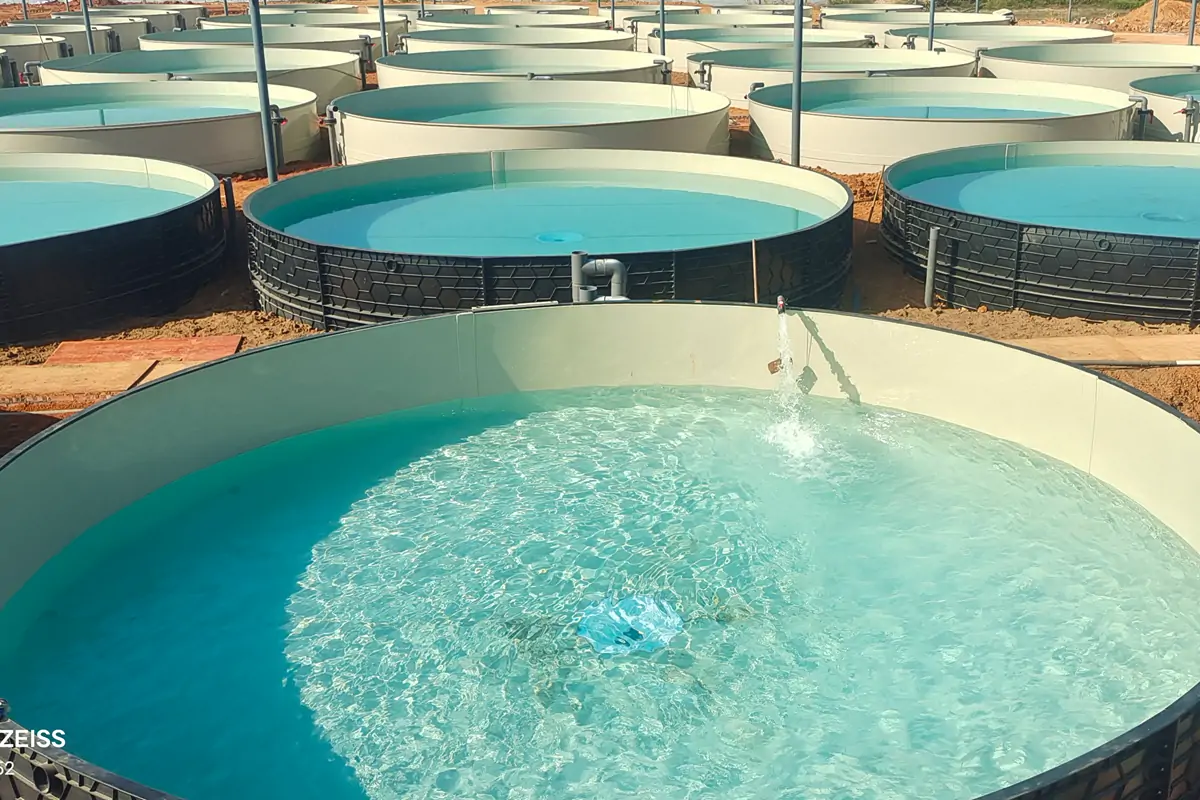
in our factory
first tank layout
Four tank types, one choice per site.
خزانات PP
Modular PP tanks
Galvanized steel tanks
Hatchery tanks
Round tanks clean themselves, if the flow is right.
Water enters tangentially and rotates. The rotation carries solids to a centre bottom drain, where they leave before they break up. How fast the water turns is set by the inlet flow, the inlet direction and the size of the inlet openings ().Oca and Masaló, Aquacultural Engineering
- takes the settled solids in a small share of the flowCentre bottom drain
- takes the bulk of the flow, with far fewer solidsSide-wall outlet
- set rotation speed for the speciesAdjustable inlets
- to the treatment loop, not the tank aloneDrain lines sized
The dual-drain tank, measured.
Cornell University and the Freshwater Institute tested the dual-drain round tank with rainbow trout at 60 kg/m³ (). The findings below set how we lay out drains and inlets.NRAC project report 97-6
Solids go to the bottom drain
Bottom-drain water averaged 19.6 mg/L TSS; side-wall water 1.5 mg/L, more than 10 times less
Send the bottom flow to the solids treatment first
Bottom drain takes a small share
Tested at 5, 10 and 20% of total flow. Used in reuse systems at about 5–20% of the reused flow
Bottom-drain share set per project
Diameter-to-depth ratio
3:1 and 6:1 flushed solids well at 2 exchanges per hour. At 12:1, solids settled around the centre drain
Diameter and depth chosen together, not diameter alone
Exchange rate
At 1 exchange per hour, solids often settled around the centre drain in most trials
Flow per tank checked against the drain layout
Fish help
Fish swimming improved how fast solids flushed to the bottom drain
Flushing checked at the stocking plan, not in an empty tank
A short pull of the bottom-drain standpipe, under a minute, was enough to flush solids that had settled around the drain in those trials.
PP, modular or steel.
A quick guide. We confirm the choice against your site and species.
البناء
One piece
Panels assembled on site
Steel wall with liner
الاستخدام النموذجي
Indoor halls, hatcheries, seawater
Large tanks indoors
Large volumes, open or semi-open sites
Transport
Ships as finished tanks
Ships flat, assembled on site
Ships flat, assembled on site
الماء
Fresh and seawater
Fresh and seawater
Freshwater, lined
Watch for
Size limited by transport and doors
Panel joints sealed and checked on site
Liner care; no bare steel in contact with water
Diameters, depths and wall thicknesses are confirmed per project and listed in the tank datasheet.
What decides the tank.
Building and site
Floor area, ceiling height, door width and whether the floor can be dug set the type and diameter.
Species and density
Bottom-living fish, fast swimmers and fry need different depths and flows. Water that turns too slowly or too fast both cost growth.
نوع المياه
Seawater rules out bare steel in contact with water. PP and lined tanks handle it.
Install time
Modular and steel tanks assemble on site. One-piece PP arrives ready.
Expansion
A grid of equal tanks makes it easy to add a treatment train later.
When the tank stops cleaning itself.
Solids collect around the centre drain
Flow too low, or tank too wide for its depth
Exchange rate; diameter-to-depth; pull the standpipe briefly
Dead zones, uneven feeding
Inlets set wrong for the rotation
Inlet direction and opening size
Fish crowd one side or tire
Rotation too fast for the species
Inlet flow and direction
Cloudy water in the tank
Solids leaving through the side outlet
Bottom-drain share; drum filter capacity
Tanks made with the loop in mind.
Made in our factory
Tanks are made in our 12,000 m² factory in Boluo, Huizhou.
Drains sized to the loop
Bottom and side outlets matched to the drum filter and pumps.
Laid out on your building
First tank layout in 3 days, free.
From one unit
OEM from one unit; standard units ship in 15 days.
Tanks in delivered farms.
52 tanks, six parallel trains, one cold winter
Keep the tanks. Change the water.
11 tanks inside a building that could not be dug
Often, yes. In Riyadh we kept 25 existing concrete tanks and rebuilt the treatment loop around them.
It depends on species, building and stocking plan, and on depth. Research on dual-drain tanks found 3:1 to 6:1 diameter-to-depth flushed solids well; wider, shallower tanks did not. We propose sizes in the first layout and explain why.
The bottom drain carries most of the solids in a small share of the flow. The side outlet carries the rest. Treating the concentrated bottom flow is easier.
One-piece PP tanks ship finished. Modular PP and galvanized steel tanks ship flat and are assembled on site.
Not with bare steel in contact with the water. For seawater we use PP or modular PP tanks.
Yes. We still check the drain and inlet sizes against your treatment loop.
Send the building. Get a tank layout.
Floor plan, species and target output are enough. The first layout comes back in 3 days, free.
- Layout, equipment list and flow balance
- Sized on your species and feed
- Made in our 12,000 m² factory
- No obligation to order