




Biofilters sized on feed, not on tank volume.
Bacteria on moving K5 media turn toxic ammonia into nitrate. Below: how the size is worked out, what to ask about media, and what to do when ammonia or nitrite rises.
moving media, included
sets the size
water
through start-up
Removes ammonia and nitrite. Not solids, not nitrate.
Fish excrete ammonia, and uneaten feed adds more. Nitrifying bacteria on the media turn it into nitrite, then nitrate. The biofilter is a living stage: the bacteria need oxygen, alkalinity and time to grow, and they use a real share of the system’s oxygen, about 20–30% of total demand by one industry estimate ().The Fish Site
- ammonia and nitrite, both harmful to fishRemoves:
- nitrate, which is far less harmful and is kept in check by water exchangeLeaves:
- solids or CO₂. A drum filter goes before it and degassing after it.Does not remove:
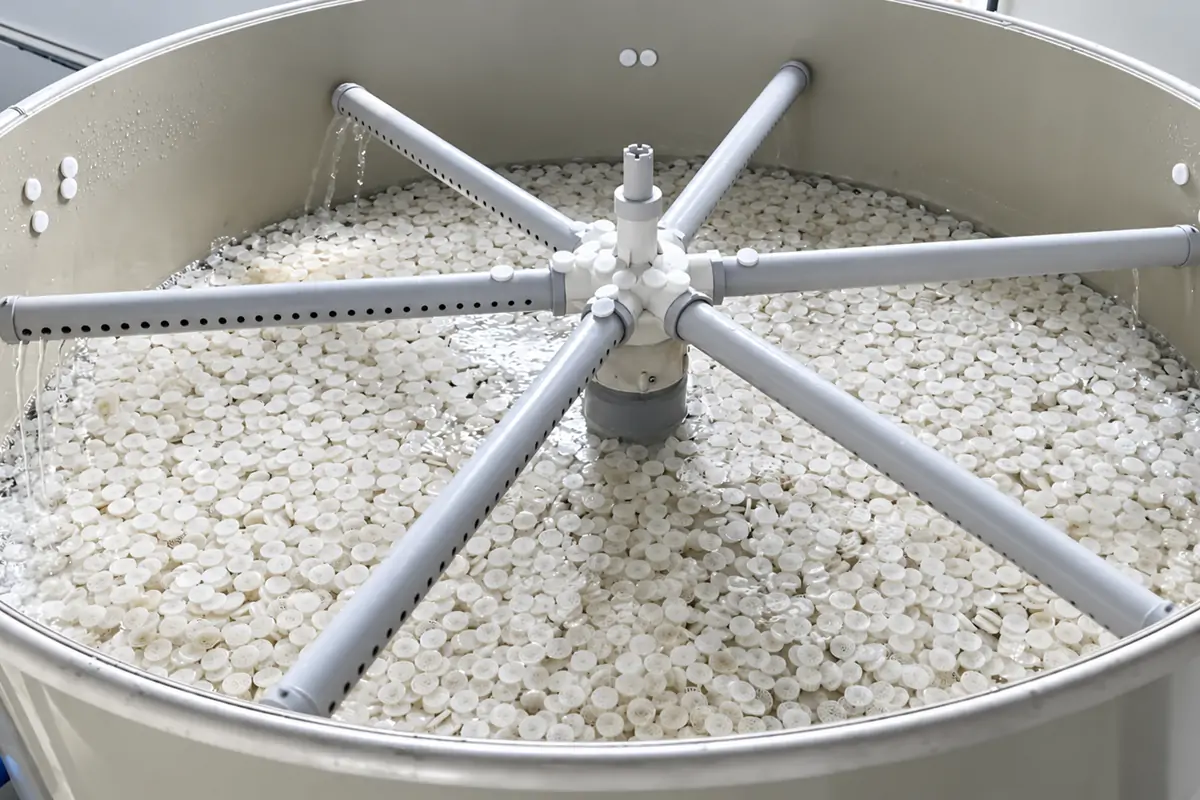
Media that never stops moving.
Moving media is the reason an MBBR does not clog. Aeration keeps it moving.
Air keeps it moving
A grid of diffusers at the bottom of the tank lifts the media and keeps it circulating through the whole volume.
Bacteria on protected surfaces
Bacteria grow on the inner surfaces of each K5 piece, protected from collisions between pieces.
Biofilm stays thin
Collisions and water movement shear off old biofilm. That shedding is normal and keeps the film active.
Screens hold the media
Outlet screens keep the media in the tank while water flows through to the next stage.
From feed to tank, in five steps.
Any supplier should be able to show you these numbers for your system. If one sizes the biofilter on tank volume, ask how much feed it was sized for.
Ammonia from feed
A standard design estimate: ammonia-N produced per day ≈ feed × protein content × 0.092. Peak daily feed goes in, not the average.
Surface the bacteria need
Divide the ammonia load by a nitrification rate per m² of media surface. This rate is the number that decides the size, and it falls in cold water and in seawater.
حجم الوسط
Divide the surface needed by the protected surface per m³ of media. That gives the volume of K5 to fill.
Tank volume
Media fills only part of the tank, so it has room to move. Fill ratio sets the tank size and the air needed to keep it moving.
Air and oxygen
The same aeration keeps the media moving and supplies the bacteria. Their oxygen use is added to the fish load when we size oxygen.
A worked example
A farm feeding 500 kg a day of 40% protein feed produces about 500 × 0.40 × 0.092 ≈ 18 kg of ammonia-N a day. If you assume the media removes twice as much per m² as it really does, the biofilter comes out half the size it needs to be. That is why the rate behind a quote matters more than the media name. Illustrative figures, not a quote.
Cold water and seawater need more media.
Nitrifying bacteria work more slowly in cold water and in seawater, so the same feed needs more surface. Published rates for moving-bed media differ several-fold with temperature and load, which is why a rate taken from a warm, high-ammonia wastewater plant should never size a cold RAS.
Warm freshwater
Fastest nitrification
Smallest biofilter for a given feed
Cold freshwater
Slower nitrification
More media; slower recovery after a disturbance
Brackish or seawater
Slower start-up and lower rates
More media and a longer, more careful start-up
Cold seawater
Slowest of all; start-up is a known difficulty
Plan the start-up time into the project, and stock in smaller steps
We size on the lowest temperature the system will see, not the average.
Questions to ask about any K5 media.
Many products are sold as K5, and their stated surface area differs. One media seller lists about 1,200 m²/m³ on one page and over 1,000 m²/m³ on another. The number that matters is the protected surface, where bacteria survive collisions.
Is the surface area protected or total?
Only protected surface holds a stable biofilm. Total surface flatters the number.
Virgin or recycled plastic?
Recycled plastic can vary in density and quality, which affects how the media moves and lasts.
What is its density?
Media must be close to the density of water so the air can keep it moving without it floating to the top.
What fill ratio was the quote based on?
Too little media wastes tank volume. Too much and it stops moving and forms dead zones.
What holds it in the tank?
Outlet screens must be sized for the flow, made for the water type, and easy to inspect.
K5 media is supplied with every MBBR we build, and can be ordered on its own for an existing biofilter. Ask for the media datasheet with your quote.
Where an MBBR fits.
MBBR (moving bed)
Handles high loads in a compact tank; does not clog; no backwash
Aeration must run all the time; a stopped blower stops the biofilter
Trickling filter
Strips CO₂ as water falls through it
Large and tall for the load it treats
Bead filter
Compact; filters solids and treats ammonia in one unit
Limited capacity; needs regular backflushing
Whatever the type, solids reaching the biofilter cut its capacity. In a yellow perch trial comparing three biofilter types, all removed less ammonia than expected because of a high organic load (). Good solids removal upstream is part of biofilter design.International Journal of Recirculating Aquaculture
A biofilter has to grow.
New media has no bacteria. The biofilter must mature before the farm is fully stocked.
1
Fill and aerate
Media goes in and aeration starts with the loop running.
2
Feed the bacteria
An ammonia source starts the nitrifying population growing.
3
Watch the numbers
Ammonia rises and falls first, then nitrite. Both must stay low before stocking.
4
Stock in steps
Each increase in feed raises the load. The bacteria need time to catch up.
When ammonia or nitrite rises.
Nitrification also uses alkalinity, so pH falls over time unless it is topped up. Most problems trace back to one of these.
Ammonia rising
Feed raised faster than the biofilter grew; cold water; low oxygen in the biofilter
Feed log; water temperature; oxygen in the MBBR
Nitrite rising after start-up
Low oxygen, a temperature or salinity change, or a treatment that hit the bacteria
Oxygen; recent changes; recent treatments
pH falling
Alkalinity used up by nitrification
Alkalinity; dose a buffer to the level your engineer set
Media not moving, dead corners
Too little air or blocked diffusers
Blower output; diffuser grid; fill ratio
Media in the next stage
Damaged or loose outlet screen
Screen and its fixing
Heavy foam on the biofilter
High dissolved organics in the water
Solids removal upstream; protein skimmer
We size the biofilter with the oxygen and the fish.
A biofilter bought on its own is sized on numbers someone gave the supplier. We size it with the feed plan, the oxygen system and the solids removal ahead of it.
Made in our factory
MBBR tanks are made in our 12,000 m² factory in Boluo, Huizhou, with K5 media supplied.
Sized on peak feed
At the lowest water temperature the system will see, with the calculation sent to you.
Standby air
We design blower capacity with a standby, because a stopped blower stops the biofilter.
On site through start-up
Our engineers stay until the biofilter keeps up with the fish load, so the first stocking is safe.
Ammonia comes from feed. Two farms with the same tank volume can feed very different amounts, and need very different biofilters.
It depends on temperature, salinity and how the bacteria are started. Warm freshwater is quickest; cold seawater is slowest. We plan it with you and stay on site until it is done.
It can speed up start-up, but it can also bring in disease. Only take media from a source whose health status you trust.
Usually, yes. Nitrification uses alkalinity, so pH drifts down unless it is topped up. Your engineer sets the target and the dosing.
Some can. Check the effect of any treatment on nitrifying bacteria before using it in the loop, and watch ammonia and nitrite closely afterwards.
The media settles and the bacteria lose oxygen. Short stops are survivable; long ones can set the biofilter back. That is why we design a standby blower.
Moving media keeps itself clean: collisions shed old biofilm. Do not wash it, or you remove the bacteria you need.
Yes. Solids reaching the biofilter add organic load and cut its ammonia removal. The drum filter protects it.
Yes. Tell us the volume of your existing biofilter and your feed load, and we check whether more media will help or whether air or tank size is the limit.
Send your feed plan. We size the biofilter.
Peak daily feed, feed protein, lowest water temperature and salinity. We return the media volume, tank size and air needed.
- Sized on peak feed
- At your lowest water temperature
- Oxygen use included
- On site through start-up