




Vent the CO₂ dense tanks build up.
Fish breathe out CO₂ and the biofilter adds more. A degassing tower strips it from the water as it falls through packing against a flow of air. Below: safe levels, how the tower is sized, and what to check.
stripped by air
set the removal
in our factory
standard units ship
CO₂ is the quiet problem.
Fish produce CO₂ as they use oxygen, and so do the bacteria. In a pond, it escapes to the air. In a dense RAS on pure oxygen, very little air touches the water, so CO₂ builds up. Fish under high CO₂ eat and grow worse even when oxygen is fine. In a 15-week trial on pikeperch in RAS, feed conversion went from 1.09 at 5 mg/L CO₂ to 1.82 at 30 mg/L, and the authors recommend staying below 15 mg/L ().Frontiers, pikeperch study
- often given a tolerance of about 10–20 mg/L; warm-water species about 20–40 mg/L ()Cold-water species:FloNergia CO₂ report
- CO₂, and lets excess nitrogen escape tooRemoves:
- add much oxygen to water already on pure oxygen; cones do that nextDoes not:
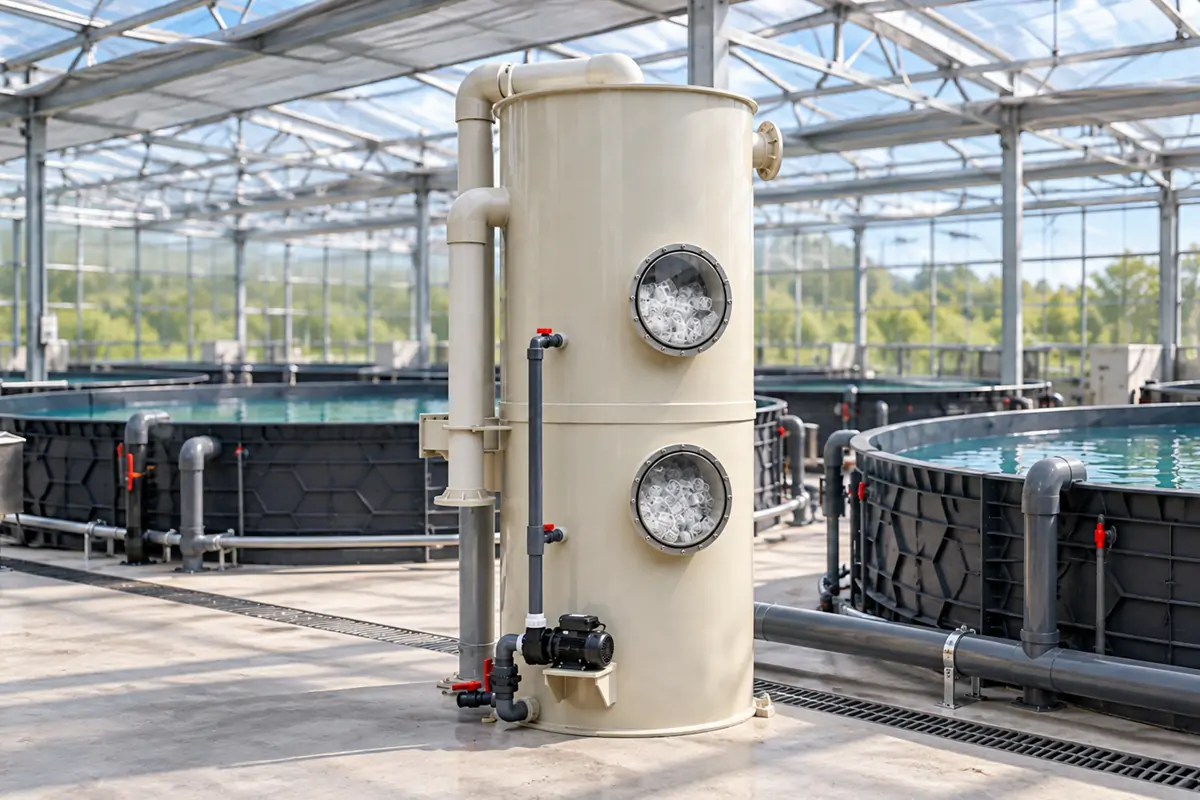
Water down, air up, CO₂ out of the building.
Water distribution
Spreads water evenly over the packing at the top
Uneven spread leaves dry packing and lowers removal
التعبئة
Large wet surface where CO₂ leaves the water
Fouled packing loses surface; clean as the manual says
Fan or blower
Moves air up through the packing, against the water
Air flow is the main control on CO₂ removal
Exhaust
Takes CO₂-rich air out of the building
Air vented back into the room raises room CO₂ and cuts removal
Sump
Collects degassed water for the oxygen cones
Air drawn into the pumps from here raises total gas pressure
Packing height and air flow do the work.
How much CO₂ a tower removes depends mainly on how tall the packing is and how much air passes per m³ of water. Feed sets how much CO₂ there is to remove.
CO₂ from feed
CO₂ is produced roughly in step with the oxygen the fish and bacteria use, so it follows peak feed.
Target in the tanks
Set the CO₂ limit for your species, then the removal needed per pass through the tower.
Packing height
Taller packing gives more contact and more removal per pass.
Air-to-water ratio
More air per m³ of water removes more CO₂, at the cost of fan energy and room ventilation.
Measured on a commercial farm
At a yellow perch RAS, a tank fed 200 kg a day held about 25 mg/L CO₂ with the stripping fan at full speed and 31 mg/L at reduced speed. Removal across the column was 45% and 24%. The fans had to run near full speed at that feed load ().Summerfelt et al., Bell Aquaculture
The air has to go somewhere.
Turning the fan down saves energy but lets CO₂ rise. At the same farm, the cost of heating the replacement air for the building was far higher than the fan electricity itself (). That makes the exhaust route and the fan control part of the tower design.Bell Aquaculture
Fan with speed control
Air flow follows the feed load, and energy falls when CO₂ is low
Exhaust to outside
CO₂-rich air leaves the building instead of raising room CO₂
Replacement air planned
The building stays at a stable pressure and temperature
CO₂ measured in the water
Fan speed can be set on a real number, not a guess
When CO₂ rises.
CO₂ rising after feeding
Air flow too low for the feed load
Fan speed; feed against the design
CO₂ high all the time
Fouled packing, uneven water spread, or exhaust air coming back in
Packing; distribution; where the exhaust goes
pH falling with CO₂
CO₂ forms acid in the water, and alkalinity is low
CO₂ and alkalinity together
Bubbles on fish
Total gas pressure high, often from air drawn into a pump
Pump suction and sump level ()IJRA 2005
Degassing sized with the oxygen.
CO₂ removal and oxygen addition are two halves of one gas balance. We size the tower and the cones from the same feed plan.
Made in our factory
Degassing towers are made in our 12,000 m² factory in Boluo, Huizhou.
Sized on feed
Packing and air flow from your peak feed and your species’ CO₂ limit.
Fan sized with it
We size the blower or fan with the tower, with a standby where required.
15 days
Standard units ship in 15 days.
What we confirm per project.
الوظيفة
Removes CO₂ by air stripping
الوسائط
High-surface packing
Air supply
Fan or blower, with standby where required
التحديد
Flow through the tower and CO₂ load from feed
Dimensions, packing height, air flow
Confirmed per model
مدة التنفيذ
Standard units 15 days
Model dimensions, packing, fan power and connections are listed in the datasheet. We confirm the model against your flow and feed before quoting.
Dense systems and systems on pure oxygen usually do, because little air touches the water. Low-density systems with plenty of aeration may not. We show it in the first layout if yours needs one.
It depends on the species. Research on pikeperch recommends below 15 mg/L, and cold-water species are often given lower limits than warm-water ones. Tell us your species and we set the target.
After the biofilter and before the oxygen cones, so oxygen goes into water that has already lost its CO₂.
Yes. The fan sets how much CO₂ comes out, so we size it with the tower.
Yes, when CO₂ is low. A commercial farm found reduced fan speed let CO₂ rise at high feed, so the fan should follow the feed load or a CO₂ reading.
With a dissolved CO₂ probe, or calculated from pH and alkalinity. Measure in the tanks after feeding, when it is highest.
It lets excess nitrogen escape as well as CO₂. But the usual causes, air leaks into pumps or heated water, have to be fixed at the source.
Send your feed plan. We size the gas stage.
Peak daily feed, species, flow and building layout. We return tower size, air flow and the exhaust route.
- Sized on feed and species
- Fan and exhaust included
- Made in our factory
- Standard units ship in 15 days