



Why backup decides whether a RAS survives
A RAS keeps fish alive with machines. Pumps move the water, blowers and oxygen systems supply the oxygen, and filters remove the waste. When power fails, all of them stop together. Oxygen in the tanks starts to fall at once, and in a densely stocked tank it can reach dangerous levels quickly.
The Global Seafood Alliance describes a farm manager whose fish survived a 20-minute power outage only because the backup oxygen opened by itself (Global Seafood Alliance). Nobody reached the farm in time. The system had to save itself.
How long do your fish have?
The time before oxygen becomes dangerous depends on how much fish the water holds, how warm it is, and how recently the fish were fed. A rough estimate:
| Step | Example assumption | Result |
|---|---|---|
| Oxygen available | Water at 9 mg/L, fish stressed below 4 mg/L | 5 g of usable oxygen per m³ |
| Fish density | 50 kg/m³ | 50 kg of fish per m³ |
| Oxygen use by the fish | About 300 mg per kg of fish per hour, warm water after feeding, example only | 15 g per m³ per hour |
| Time to the danger level | 5 g ÷ 15 g per hour | about 20 minutes |
The real oxygen use depends on species, size and temperature, so ask for a figure for your fish. The scale is the point: at commercial densities the safe time is measured in minutes, not hours. Bacteria in the biofilter keep using oxygen too, which shortens it further. Your backup plan must work within that time, without anyone on site.
What can fail
| Failure | What happens | Backup |
|---|---|---|
| Grid power cut | Everything stops at once | Generator with automatic transfer switch; emergency oxygen that needs no power |
| Main pump stops | No flow to tanks or filters | Standby pump that starts automatically |
| Blower stops | No air to biofilter or diffusers | Standby blower |
| Oxygen generator stops | Oxygen supply falls | Liquid oxygen or cylinder backup that opens on low pressure |
| Control or sensor fault | Alarms do not fire | Independent low-oxygen alarm, regular sensor checks |
| Drain or screen blockage | Tanks overflow or drain | Overflows, level alarms |
Backup power
A generator sized for the critical loads, with an automatic transfer switch, restarts the farm without waiting for a person. Size it for what must run, not for the whole site: circulation pumps, blowers, the oxygen supply and the controls. Lighting, heating and feeders can usually wait. Test the generator under load every month; one that has never started under load cannot be trusted.
Where the grid is weak, also think about how pumps restart. Starting every motor at once can overload the generator. Staged restarts or soft starters prevent this.
Emergency oxygen
Emergency oxygen is the last line of defence because it works with no power at all. A liquid oxygen tank or a bank of cylinders feeds diffusers in each tank through a valve that opens when power is lost or pressure falls. This keeps the fish alive while the water stands still.
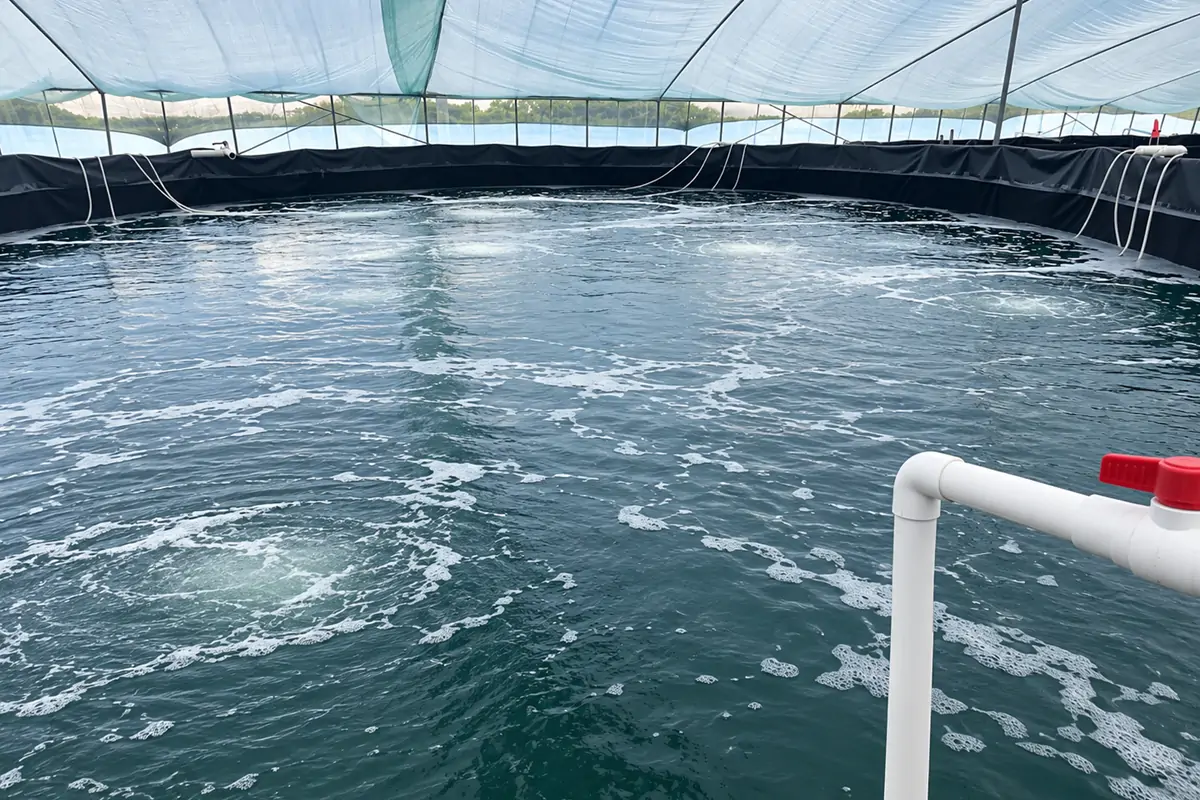
Size the emergency supply to cover the fish’s oxygen use for at least the time it takes to restore power or reach the site, with margin. A PSA oxygen generator stops with the power, so it cannot be the emergency supply on its own. Many farms run on PSA and keep liquid oxygen as backup. Oxygenation in RAS compares the options.
Standby pumps and blowers
For each unit the farm cannot run without for an hour, install a standby that takes over on its own. Common practice is one more unit than needed: if two pumps carry the flow, install three. The standby should be wired to a different circuit where possible, so one electrical fault does not stop both.
Also split the system where you can. Two or more drum filters, pumps or biofilter sections mean one can be serviced or fail while the farm keeps running.
Alarms that reach someone
- Low oxygen in each tank or tank group.
- Power failure, on a battery-backed alarm unit.
- Pump and blower stop.
- Low water level in the sump.
- Low oxygen supply pressure.
Send alarms by phone call or text to at least two people, and test the chain every month by triggering an alarm on purpose. Our monitoring and control systems can also act on alarms: opening backup oxygen or starting standby units without waiting for a person. See water quality parameters in RAS for what else to monitor.
A written emergency plan
Equipment is half the plan. The other half is what people do. Write down, and post on site:
- Who is called, in what order, and who has the keys.
- How to start the generator and open emergency oxygen by hand if the automatic system fails.
- Which tanks to stop feeding first, since fasting fish use less oxygen.
- Where spare parts are kept, and the supplier’s contact for urgent help.
Run a drill a few times a year. The first real failure is the wrong time to find out the generator battery is flat.
Backup belongs in the first budget
Standby units and emergency oxygen are often the first items cut to lower a quote, and the most expensive to leave out. When comparing offers, check that each names its standby units, emergency oxygen and alarms. How much a RAS fish farm costs lists what to ask. Send your species, density and site conditions, and we size the backup with the rest of the system.