



Why pH falls in a RAS
Fish excrete ammonia. In the biofilter, nitrifying bacteria turn it into nitrite and then nitrate. This reaction releases acid. Each gram of ammonia nitrogen nitrified uses about 7.14 g of alkalinity, measured as calcium carbonate (Timmons and Ebeling, Recirculating Aquaculture). Fish and bacteria also breathe out CO₂, which forms carbonic acid in the water.
A pond or flow-through farm replaces this alkalinity with new water. A RAS reuses most of its water, so the alkalinity used each day is not replaced unless you add it. The result is a slow, steady fall in pH that speeds up as the feed rate grows.
Why it matters
- The biofilter slows. Nitrifying bacteria work best at moderate pH and need alkalinity as a carbon source. When alkalinity runs low, ammonia and nitrite removal falls and both start to rise.
- pH swings get larger. Alkalinity is the water’s buffer. With little buffer, pH can move sharply between feeding and night.
- Toxicity shifts. Ammonia is more toxic at high pH, while low pH raises the share of CO₂ in its harmful form. Neither extreme is safe.
A biofilter that suddenly “stops working” weeks after start-up is often a biofilter that has run out of alkalinity.
What to hold
| Parameter | Common working range | Notes |
|---|---|---|
| pH | About 7.0–8.0 | Narrower targets depend on species; hold it steady rather than chasing one value |
| Alkalinity | About 100–150 mg/L as CaCO₃ | Below roughly 50 mg/L the buffer is weak and nitrification suffers |
| CO₂ | About 10–20 mg/L cold water, 20–40 mg/L warm water | Tolerance ranges from FloNergia |
These are typical design ranges, not guarantees for every species. Marine systems start with high natural alkalinity but still use it up at the same rate.
How much to add each day
Most farms dose sodium bicarbonate (baking soda). It is cheap, safe to handle and raises alkalinity without a sharp pH jump. One gram of sodium bicarbonate adds about 0.6 g of alkalinity as CaCO₃, so replacing 7.14 g of alkalinity takes about 12 g of bicarbonate per gram of ammonia nitrogen nitrified.
A simpler rule of thumb used in RAS design is about 0.25 kg of sodium bicarbonate for each kg of feed (Timmons and Ebeling). The real dose is usually below the full chemical figure because some alkalinity comes in with make-up water and some is returned by denitrification in sludge.
Worked example
Using the example farm from RAS design basics: 480 kg of feed per day, producing about 14 kg of ammonia nitrogen.
| Method | Calculation | Sodium bicarbonate per day |
|---|---|---|
| Rule of thumb | 480 kg feed × 0.25 | about 120 kg |
| Full nitrification, no other inputs | 14 kg TAN × 12 | about 170 kg |
Start near the rule of thumb, then adjust from measured alkalinity. The point of the example is the scale: a mid-size farm uses tonnes of bicarbonate per month, so storage, handling and a reliable supply belong in the plan.
How to dose
- Small, frequent doses. Several doses a day, or continuous dosing, keep pH steady. One large dose a day causes a daily swing.
- Dose into mixed water. Add it where the flow is strong, such as the sump or the biofilter inlet, never straight into a fish tank.
- Automate on larger farms. A dosing pump with a solution tank, controlled by a pH sensor or a timer, removes the daily manual job. See monitoring and control.
- Other products. Lime products such as calcium hydroxide add more alkalinity per kg but raise pH sharply and need careful control.
Remove CO₂ as well
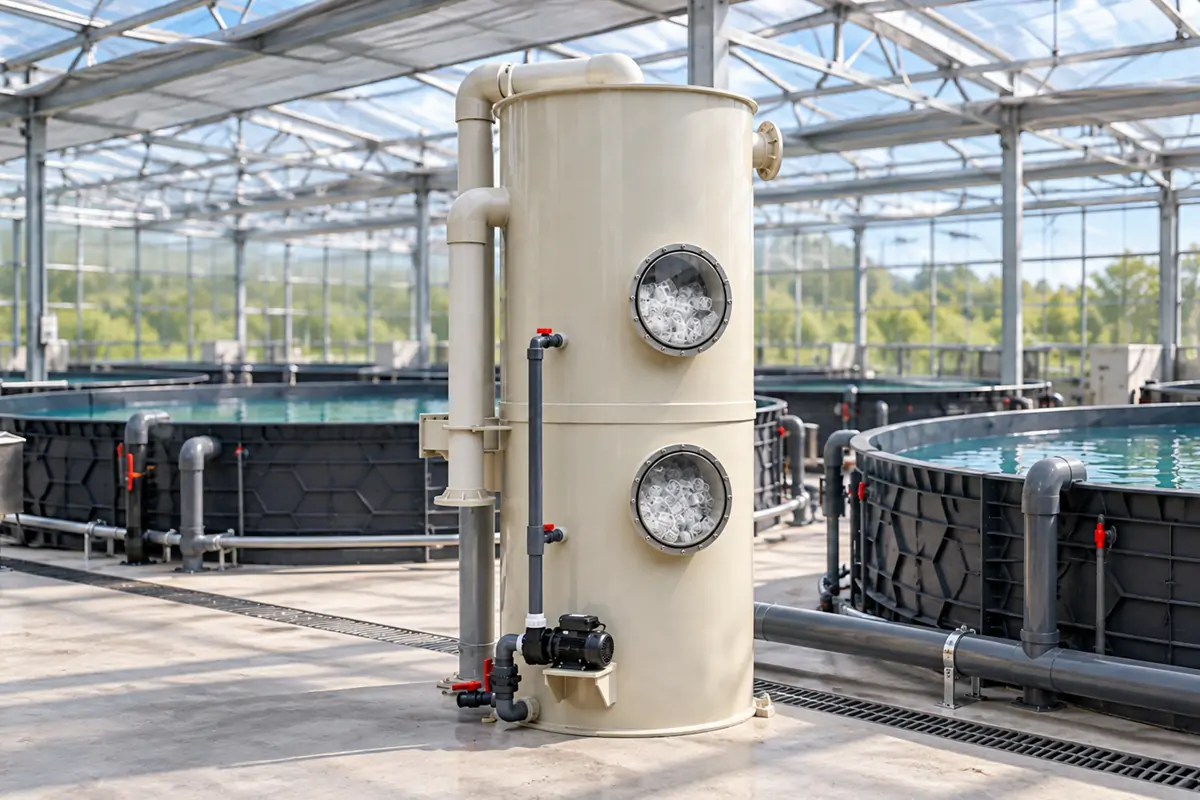
Adding bicarbonate does not fix a CO₂ problem. In dense systems, especially those on pure oxygen, CO₂ builds up because there is little air contact. A degassing tower strips it out and raises pH without chemicals. In practice, good degassing lowers the bicarbonate needed to hold pH. Read oxygenation in RAS for how degassing fits with the oxygen system.
What to measure
| Measurement | How often | How |
|---|---|---|
| pH | Daily, or continuous sensor | Calibrated meter or online probe |
| Alkalinity | Two to three times a week, daily during start-up | Titration test kit |
| Ammonia and nitrite | Daily during start-up, then weekly | Test kit or photometer |
| CO₂ | Weekly, or when fish feed poorly | Test kit, or calculated from pH and alkalinity |
Watch the trend, not one reading. A steady fall in alkalinity over a week tells you to raise the dose before the biofilter suffers. Water quality parameters in RAS covers the full monitoring plan.
During biofilter start-up
A new biofilter is often started with added ammonia before the fish arrive. Alkalinity is used from the first day the bacteria grow, so check it daily and dose from the start. The biofilter start-up guide explains the full sequence.
Plan it at the design stage
Alkalinity dosing is easy to leave out of a design and costly to add later: it needs a dosing point, a chemical store and, on larger farms, a dosing pump and pH control. Send your feed plan and water analysis, and we include the dosing system and the degassing in the first layout.