




Push CO₂ out. Put oxygen in.
Dense tanks run short of oxygen and build up CO₂. Degassing towers vent the CO₂, then PSA oxygen and oxygen cones dissolve oxygen back into the return flow. All of it is sized from your feed.
sets oxygen and CO₂
PSA oxygen generation
vented by degassing towers
oxygen and blowers designed in
Three units in one sequence.
Order matters. CO₂ comes out first, then oxygen goes in, so the cone works on water that can take it.
01
Degas
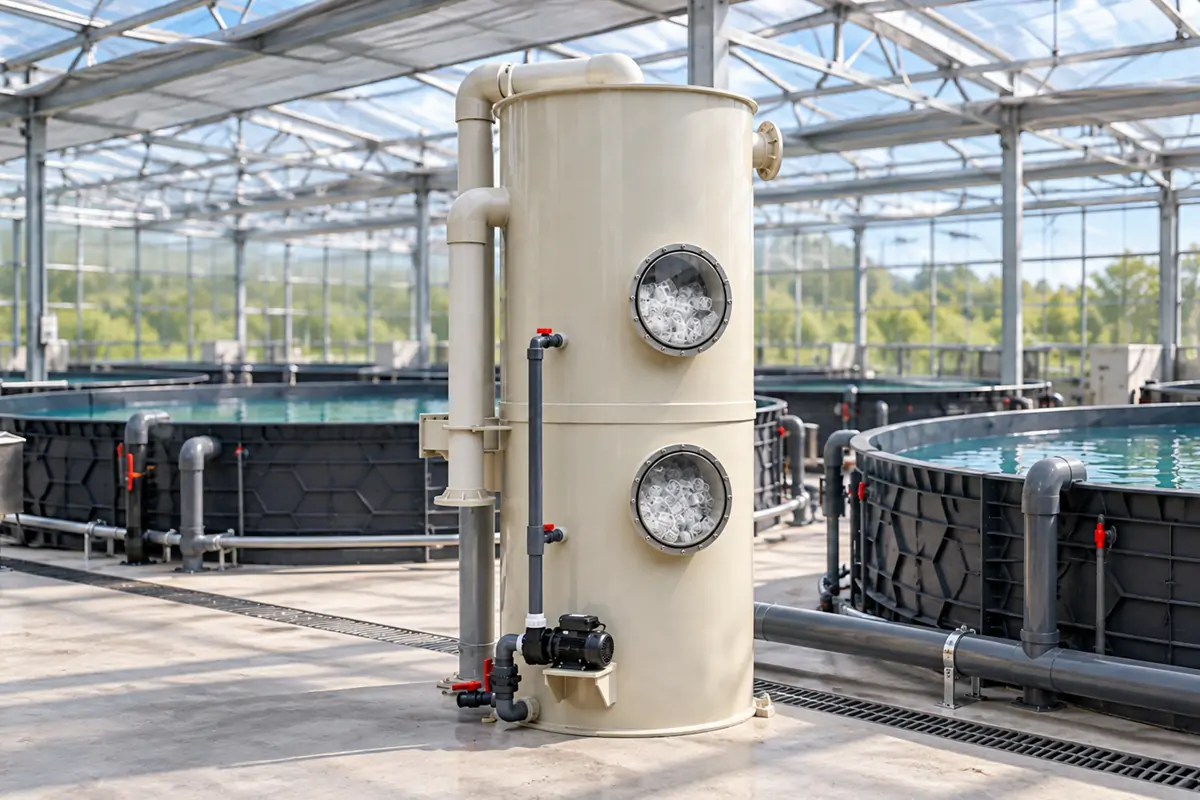
A degassing tower strips CO₂ as water falls through packing against a flow of air.
02
Generate
A PSA generator separates oxygen from compressed air on site.
03
Dissolve
An oxygen cone dissolves the oxygen under pressure into the return flow.
04
Back to the tanks
Oxygen-rich, low-CO₂ water returns to the fish.
One feed plan sets both numbers.
Every kg of feed uses oxygen and produces CO₂. A common rule of thumb is about 350 g of oxygen per kg of feed for the fish (), plus what the bacteria use. The CO₂ produced rises in step. So the generator, cones and degassing tower are sized from the same number.Novair
Oxygen to deliver, side-stream flow and pressure
Oxygen is made but does not reach the water
Blowers
Air for MBBR, degassing and low-density tanks
The biofilter and degassing slow down
CO₂ matters as much as oxygen. In a pikeperch RAS trial, feed conversion worsened from 1.09 at 5 mg/L CO₂ to 1.82 at 30 mg/L ().Frontiers
Oxygen and aeration equipment.
PSA oxygen generators
Oxygen cones
Degassing towers
Where air is enough.
Not every tank needs pure oxygen. Blowers supply air for MBBR biofilters, degassing and tanks at lower density. We design blower capacity with a standby, because a stopped blower stops the biofilter too.
- keeps K5 media movingAir for MBBR
- strips CO₂Air for degassing
- at lower stocking densityTank aeration
- blowersDuty and standby
Plan the bad hour, not the average day.
Fish keep using oxygen when the power or the generator stops. The backup is sized on how long your site must survive, and it should start on its own.
Power cut
Generator, pumps and blowers stop
Generator set; liquid oxygen or cylinders to diffusers in the tanks
Generator fault
Oxygen supply stops; pumps still run
Liquid oxygen or cylinders to the cones, with automatic changeover
Blower fault
MBBR media settles; degassing slows
Standby blower
It depends on stocking density and temperature. Air holds only about a fifth oxygen, so dense systems usually need pure oxygen to keep up. We show the oxygen balance in the first layout.
High CO₂ harms fish even when oxygen is fine, and water low in CO₂ is the right water to add oxygen to. So the tower goes first and the cones after.
Start from peak daily feed: about 350 g of oxygen per kg for the fish, plus the bacteria, sized on the peak hour. Send your feed plan and we do the full calculation.
We design a standby oxygen supply. Tell us how long your site can be without power and we size it.
PSA suits most sites as the main supply. Liquid oxygen or cylinders make a good backup.
Send your feed plan. We balance the oxygen.
Peak daily feed, species, water temperature and how long your site can be without power.
- Oxygen and CO₂ from one feed plan
- Generator, cones and tower sized together
- Backup sized per site
- No obligation to order