




Year-round production under one roof.
Indoors you control temperature, light and biosecurity. The building becomes part of the system: its floor, height, insulation and power decide the design. We fit the system to a new hall or an existing building, including ones that cannot be dug.
fitted in Japan, no digging
year-round power swing, insulated RAS (study)
is enough to start
first layout
We specify it. You or your builder provide it.
Floor area and layout
Tanks, treatment trains, walkways and service space
Floor plan; room for a future train
Floor levels and drains
Tank drains run to the drum filter by gravity
Whether the floor can be dug; if not, drains stay above it
Floor load
Full tanks are very heavy
Slab capacity under tanks and filters
Height
Degassing towers, oxygen cones and lifting
Clear height; access for equipment
Insulation
Heat or cooling cost all year
Walls and roof; climate
Ventilation
CO₂ from degassing, humidity, any ozone room
Air changes; separate ozone room
Power and backup
Pumps, blowers and oxygen run 24 hours a day
Supply, voltage and generator
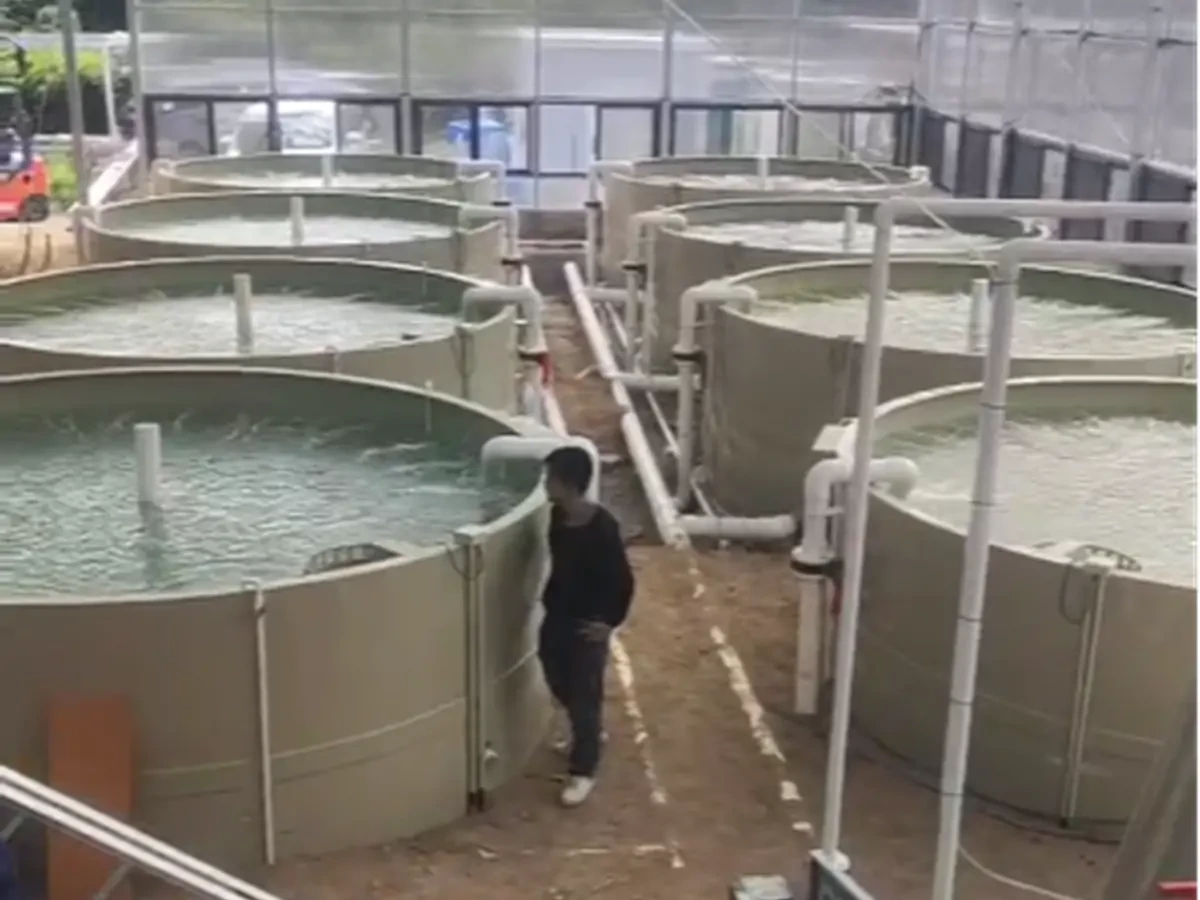
11 tanks in a building that could not be dug.
The Japan eel nursery sits inside a building that could not be dug. Tanks, drains and the treatment loop all had to fit without digging. We fitted 11 tanks and the loop into it without excavation.
- eel nursery240 m³
- indoors11 tanks
- in the buildingNo excavation
A good building pays for itself in energy.
A commercial indoor RAS in Sweden, in old insulated farm buildings, held tilapia and catfish water around 30 °C all year with electricity use varying only about ±15% between seasons. Energy use was about 3.1 kWh per kg of tilapia and 0.8 kWh per kg of catfish, and the farm needed no oxygenation ().Bergman et al., Environ. Sci. Technol., 2020
Insulated walls and roof
Heat stays in; smaller seasonal swing
Heat exchangers
Heat recovered from outgoing water and air
Low make-up water
Less new water to heat or cool
Species matched to climate
Warm-water fish in a cold country cost heat; cold-water fish in a hot country cost cooling
These are one farm’s published figures, not a guarantee for yours. Energy depends on species, climate, building and power source.
What runs the building around the clock.
Ventilation
Removes CO₂ vented from degassing and the humidity of warm water
Ozone room
Separate, ventilated, with an ozone monitor, if ozone is used
Lighting
Controlled photoperiod where the species needs it
Backup power
A generator with automatic start, and backup oxygen that opens on power loss. One farm manager’s fish survived a 20-minute outage only because backup oxygen opened by itself ()Global Aquaculture Advocate, 2010
Alarms
Oxygen, pump, level and power alarms to more than one phone
Drawings in 3 days. A packed system in 35.
3days
First layout
Tank layout, equipment list and flow balance, free.
7days
Samples
Sample units for OEM and distributor orders.
15days
Standard units
Standard equipment built and packed.
35days
Custom system
Built, tested and packed. Install and start-up follow on site.
We fit the system to the building.
Existing buildings
Japan: 11 tanks, no digging.
Cold and hot climates
Kazakhstan’s winter; Saudi Arabia’s heat.
Building spec in writing
What your builder must provide, with the layout.
On site to start-up
Engineers stay until the biofilter is running.
Farms fitted to a building or a climate.
11 tanks inside a building that could not be dug
52 tanks, six parallel trains, one cold winter
Keep the tanks. Change the water.
Yes. Send the floor plan, height and photos. We check whether drains can go into the floor or must stay above it.
We specify what the building must provide. The structure is agreed per project.
We size heating or cooling on your climate and the species’ range. Insulation and low make-up water do most of the work.
It depends on species, climate and building. One published indoor RAS in Sweden used about 3.1 kWh per kg of tilapia. We estimate yours from the layout.
Drains and levels are planned without floor trenches, so gravity flow still reaches the filters. In Japan we fitted the whole farm into a building that could not be dug.
For almost every indoor farm, yes, with automatic start and backup oxygen.
Send the building. Get an indoor layout.
Floor plan, height, photos, species and target output. A first layout comes back in 3 days, free.
- Layout fitted to your building
- Building spec in writing
- Heat, air and power planned
- No obligation to order