




Tilapia RAS, from cold winters to desert heat.
Tilapia are hardy, but a dense tilapia RAS is limited by oxygen, CO₂ and temperature long before space. Below: the targets we design to, how density sets the feed load, and three farms we delivered.
delivered tilapia farms
largest, Abha
project-reported, Riyadh
countries
What a tilapia system has to hold.
Tilapia tolerate poor water better than most farmed fish, but growth and feed conversion drop well before they die. These are the published targets for tank culture (); we design the loop to hold them at peak feeding.SRAC Publication 282
Suhu
27–29 °C for best growth; 25–32 °C acceptable
Heating or cooling, building insulation
Oksigen terlarut
5.0–7.5 mg/L; growth suffers below 3.5 mg/L
Oxygen supply sized on peak feed
Carbon dioxide
Below 40 mg/L
Menara degassing
Un-ionized ammonia
Below 1.0 mg/L
MBBR biofilter sized on feed
Nitrit-N
Below 5 mg/L when chloride is low; keep chloride at 150–200 mg/L
Biofilter; salt dosing
Nitrate-N
Below about 300–400 mg/L
Pertukaran air
pH
6–9 for growth; at least 6.8 for the biofilter
CO₂ removal; alkalinity dosing
Short exposure, under 10 minutes, to oxygen as low as 0.8 mg/L can be survived. A RAS should never be designed to rely on it.
Density decides the feed load. Feed decides the plant.
A tilapia system is designed backwards: target harvest size and tonnage first, then maximum density, then the feed that density needs. Market-size fish are usually fed 1.0–1.5% of body weight a day. Highly aerated systems reach about 30 kg/m³; operators with pure oxygen and efficient solids removal report 60–72 kg/m³ ().SRAC Publication 282
- about 30 kg/m³ is the usual ceilingAeration only:
- 60–72 kg/m³ reportedPure oxygen and good solids removal:
- 1.4–1.8 is common for tank-grown tilapiaFeed conversion:
- project-reported density rose from 20 to 50 kg/m³ after we rebuilt the loopIn Riyadh:
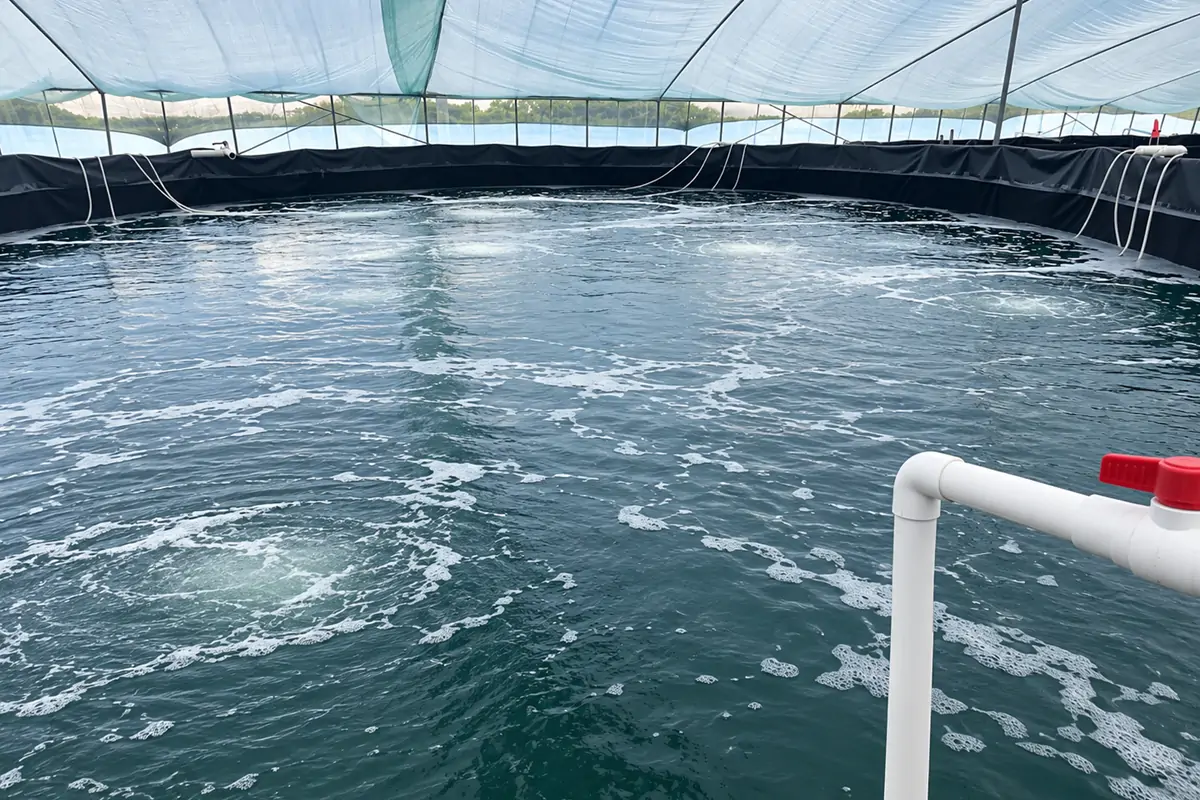
From tank volume to peak feed.
The same arithmetic we run in a first layout. Illustrative figures, not a quote.
Volume budidaya
1,000 m³ of tanks.
Design density
50 kg/m³ with pure oxygen gives 50 t of standing fish at peak.
Peak feed
1.0–1.5% of 50 t is 500–750 kg of feed a day.
What it sizes
Biofilter, oxygen and degassing on 750 kg/day; drum filter and pumps on peak flow.
Halve the density and the feed load halves with it. That is why the density target is the first number we agree.
Heat in the cold, shade and cooling in the heat.
Tilapia sit in a narrow temperature band. Where the farm is decides much of the running cost.
Cold winter
Water falls below 25 °C; heating costs
Insulated building, heating, limited make-up water
Kazakhstan, 52 tanks
Hot, dry climate
Water above 32 °C; oxygen harder to hold
Indoor building, cooling, oxygen sized for warm water
Riyadh
Warm, stable
Few; peak feeding is the limit
Oxygen and degassing on peak feed
—
Every stage sized on the same feed number.
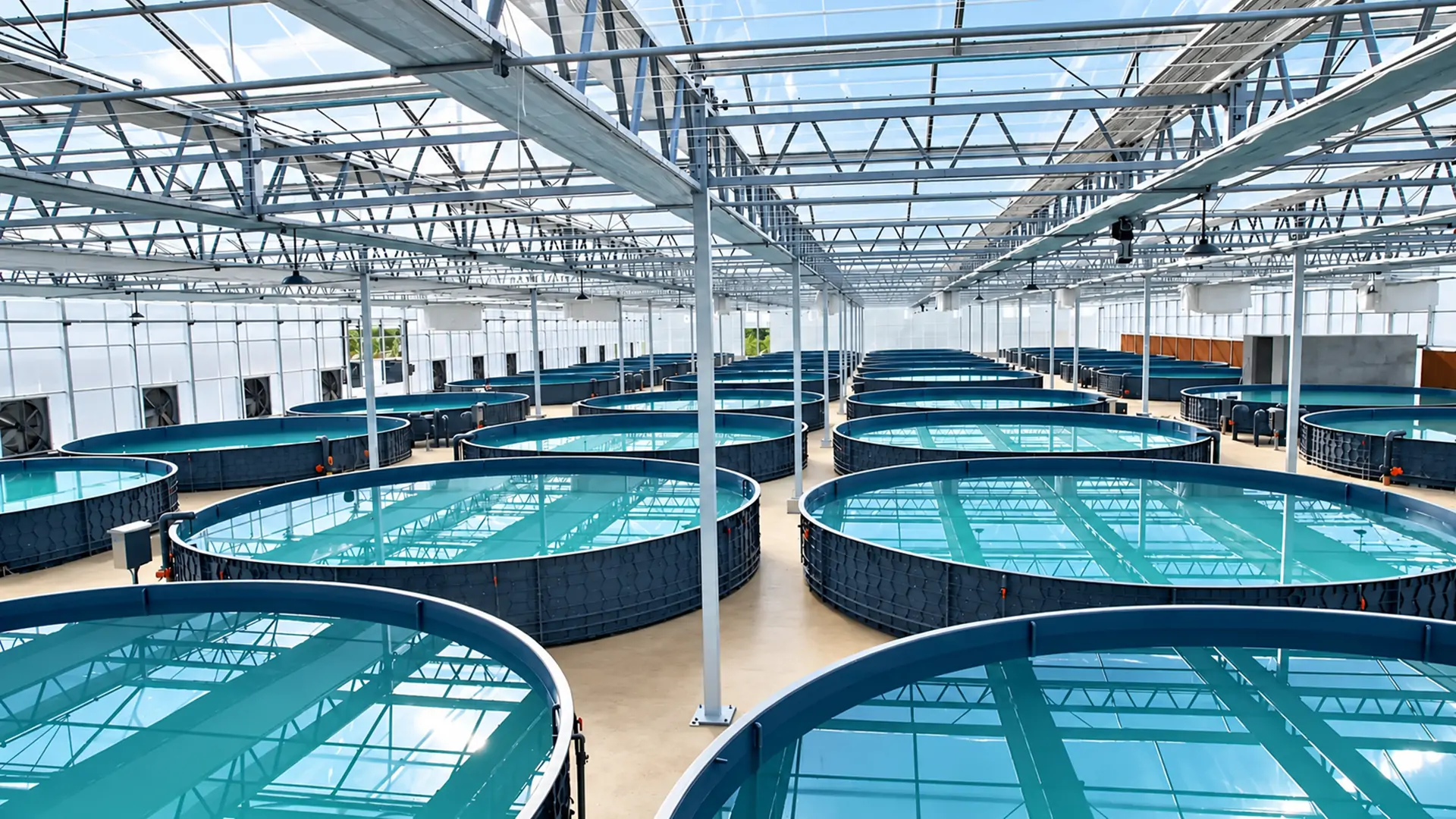
Water leaves the tanks carrying solids, ammonia and CO₂, and short of oxygen. Each stage removes one problem.
- removes solids before they break downFilter drum
- turns ammonia into nitrateBiofilter MBBR
- keeps CO₂ under 40 mg/LMenara degassing
- oxygen in at peak feed; UV before the water returnsOxygen and UV
When tilapia stop eating.
Slow feeding, lethargic fish
CO₂ too high
CO₂ reading; degassing air flow
Gasping at the surface after feeding
Oxygen too low at peak
DO in the tank, not only the return
Brown blood, poor appetite
Nitrite high, chloride low
Nitrite and chloride; add salt
pH falling week by week
Alkalinity used by nitrification
Alkalinity; dosing
Growth slows in winter
Water below 25 °C
Temperature log; heating
We have built tilapia farms in both extremes.
Cold and hot sites
Kazakhstan’s winter and Saudi Arabia’s heat.
Upgrades as well
Riyadh kept all 25 concrete tanks.
Made in our factory
Tanks, drum filters, MBBR and UV from our 12,000 m² factory.
On site to start-up
Engineers stay until the biofilter is running.
Tilapia farms we delivered.
52 tanks, six parallel trains, one cold winter
Keep the tanks. Change the water.
Yes. Our Kazakhstan farm runs 52 tanks through a cold winter. Heating, insulation and limited make-up water are part of the design, because tilapia grow best at 27–29 °C.
About 30 kg/m³ with aeration alone, and 60–72 kg/m³ reported with pure oxygen and efficient solids removal. In Riyadh, project-reported density rose from 20 to 50 kg/m³ after the upgrade.
Above about 30 kg/m³, almost always. Air alone cannot dissolve enough oxygen in warm water at that feed load.
Chloride protects the fish against nitrite. Published practice is 150–200 mg/L chloride.
1.4–1.8 is common in tank culture. A low FCR from underfeeding is not a good result, so we look at growth too.
Yes. Send photos, tank sizes and current feed. In Riyadh we kept 25 concrete tanks and rebuilt the loop around them.
On peak daily feed, which comes from target density and tank volume. We agree the density first.
A first layout comes back in 3 days, free.
Send your target output. Get a tilapia layout.
Target tonnage, site, climate and water source. A first layout comes back in 3 days, free.
- Layout, equipment list and flow balance
- Sized on your species and feed
- Made in our 12,000 m² factory
- No obligation to order